
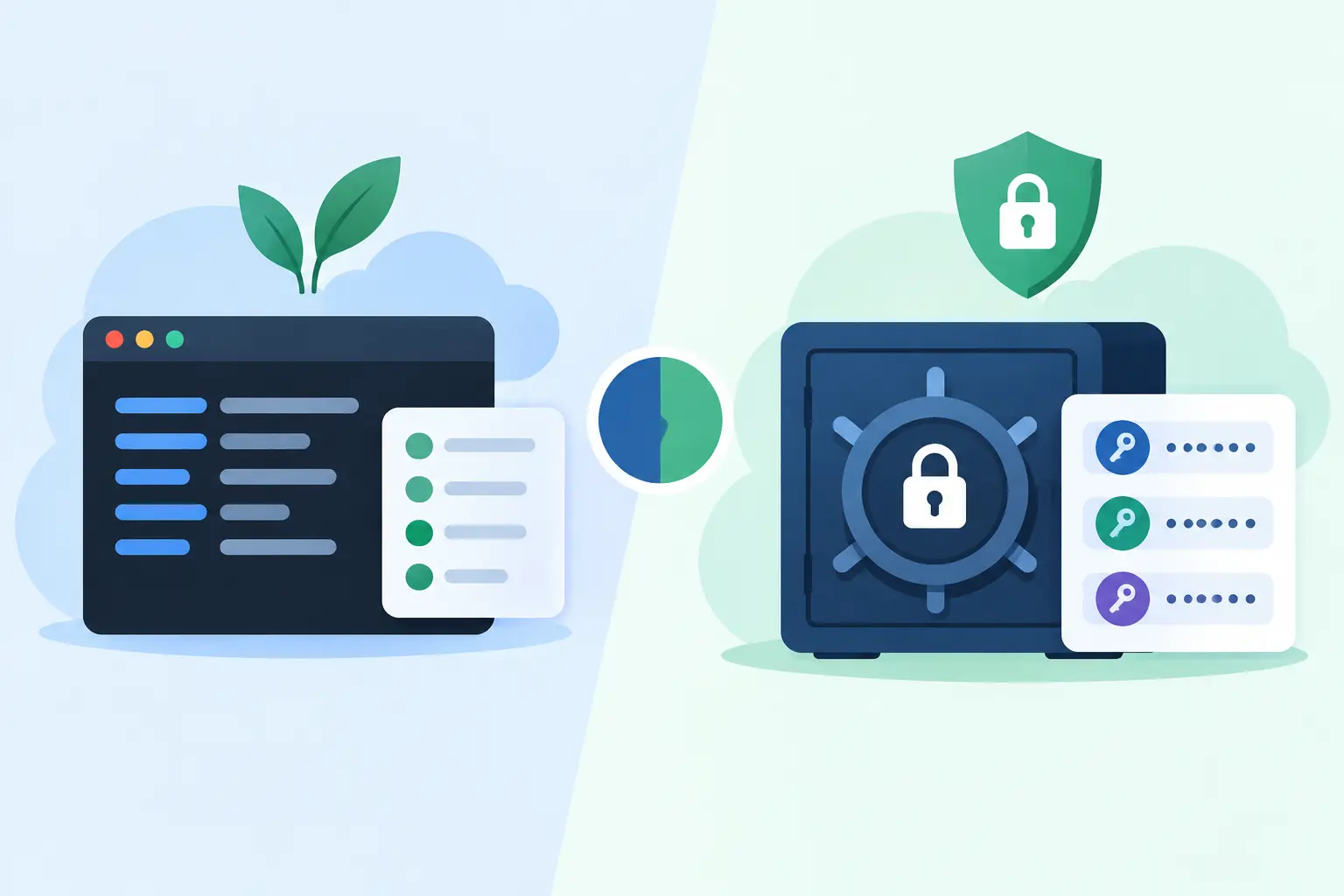
A production incident rarely starts with a developer deliberately exposing a credential. More often, it starts with a shortcut that outlived its original context: a `.env` file copied into a build job, a database password passed through a deployment command, or a vendor API key pasted into a support ticket. The environment variables vs secret managers decision determines whether those shortcuts become routine operational risk.
Environment variables remain useful. They are portable, supported by nearly every runtime, and easy to inject into a process. But they are a delivery mechanism, not a complete security system for sensitive data. Secret managers solve a different and broader problem: controlling who can retrieve a secret, under what conditions, for how long, and with what evidence.
Environment Variables vs Secret Managers: The Core Difference
An environment variable is a key-value pair available to a running process and, often, its child processes. Application frameworks use them for configuration because they avoid hardcoding values in source code. A service can read `DATABASE_URL` or `PAYMENT_API_KEY` at startup without requiring a code change for each environment.
That convenience is not equivalent to secret lifecycle management. Environment variables do not natively encrypt values, rotate credentials, enforce fine-grained retrieval policies, create meaningful access audit trails, or revoke a leaked value. Their security depends almost entirely on the systems that inject, store, and expose them.
A secret manager is a purpose-built control plane for secrets such as passwords, API keys, private keys, certificates, tokens, and connection strings. It typically encrypts values at rest, applies identity-based access policies, logs access events, supports versioning, and can automate rotation. Mature implementations can issue short-lived database credentials or cloud tokens rather than distributing a static credential that persists for months.
The distinction matters because deployment is only one phase of secret handling. A secure program must account for creation, storage, access, distribution, rotation, revocation, and retirement. Environment variables address only the last-mile handoff to an application process.
Where Environment Variables Are Still the Right Choice
The right comparison is not environment variables or secret managers. In most well-designed architectures, they work together.
Environment variables are appropriate for non-sensitive configuration: deployment region, log level, feature flags that do not grant access, service ports, and runtime mode. They can also carry a short-lived credential fetched by a trusted workload at startup, provided the environment is tightly controlled and the value is not written to logs or exposed through diagnostics.
They are especially practical when an application expects configuration through its environment. Rewriting every application to query a secret manager directly can create unnecessary coupling and complicate local development. A sidecar, deployment controller, or startup agent can retrieve the secret through workload identity, then inject it into the runtime environment for a limited period.
This pattern has limits. Once a process receives a secret through an environment variable, the secret may be visible to debugging tools, crash dumps, process-inspection utilities, child processes, or administrators with host-level access. Some platforms expose environment settings in deployment dashboards and audit exports. A variable is only as protected as every layer that can inspect it.
For short-lived jobs with narrowly scoped access, this risk may be acceptable. For long-running services holding privileged database credentials, it usually is not sufficient on its own.
What a Secret Manager Adds
A secret manager centralizes sensitive values and replaces informal distribution paths with policy-driven retrieval. Instead of adding a production credential to a CI variable, a team grants the deployment workload permission to read one specific secret. Instead of sharing a password in chat, an operator retrieves it through an authenticated workflow with a recorded event.
The highest-value capabilities are often identity, scope, and time. Workload identity lets a service prove what it is using cloud-native identity, mutual TLS, or another attestation mechanism. Scope limits that service to only the secrets it needs. Time limits reduce the damage when a credential is copied, logged, or extracted from memory.
Rotation is equally significant. Static secrets create a difficult choice after an employee departure, vendor change, or suspected exposure: rotate immediately and risk breaking production, or delay and accept exposure. A secret manager with versioning and coordinated rollout support makes rotation an engineering process rather than an emergency event.
Auditability changes the incident-response equation. If a credential appears in a public repository, security teams need to know where it was used, who retrieved it, which workloads had access, and whether replacement values have propagated. Environment variables rarely provide that context by themselves. A secret manager can provide a retrieval record, although logs must still be protected because metadata about sensitive systems has value to an attacker.
The CI/CD Problem Most Teams Underestimate
CI/CD systems are a frequent secret boundary because they connect source control, build infrastructure, deployment targets, and third-party integrations. A single pipeline token may be able to publish packages, deploy to production, or access cloud infrastructure.
Storing encrypted secrets in a CI/CD platform is better than placing them in repository files, but it is not automatically a complete solution. Consider who can edit pipeline definitions, trigger builds from forks, view job output, download artifacts, or access self-hosted runners. A masked value can still be exfiltrated if an attacker can modify a job to send it elsewhere.
The stronger design is to minimize long-lived secrets in the pipeline. Use federated identity between the CI/CD platform and the cloud provider when available. The job receives a short-lived token after satisfying defined conditions, then accesses only the deployment resources it needs. A secret manager can hold values that cannot yet be replaced with ephemeral credentials, while policy prevents broad project-level access.
Treat masking as a safeguard against accidental display, not an authorization boundary. Redact known secrets from logs, prevent shell tracing around sensitive commands, and ensure build artifacts never contain configuration files or generated output with embedded credentials.
Choosing an Architecture by Risk
A startup with one service and a small engineering team does not need the same design as a regulated SaaS platform operating across multiple cloud accounts. However, both need a clear answer to a basic question: what happens if this value is exposed?
Use environment variables for ordinary configuration and, where necessary, for carefully controlled last-mile injection. Use a secret manager when the value grants access to production data, customer systems, payment infrastructure, signing keys, privileged cloud roles, or high-value third-party services.
The decision should also account for operational requirements. A static API key used only in a low-risk development sandbox may not justify an elaborate retrieval system. A production database credential shared across services absolutely warrants central storage, access segmentation, rotation planning, and retrieval auditing.
Avoid treating a secret manager as a reason to store every secret indefinitely. Inventory owners, consumers, purpose, expiration expectations, and rotation procedures. Remove unused values. Prefer separate credentials per service and environment so revoking one compromised value does not create a broad outage.
Third-Party Secret Collection Needs Its Own Control
Secret managers protect secrets after they enter your controlled environment. They do not solve the first-mile problem of receiving a credential from a customer, contractor, or implementation partner. Asking someone to email a password, paste a key into chat, or upload it to a shared document creates copies outside the intended control plane before the secret reaches a vault.
Use a dedicated collection channel with encryption, expiration controls, and a defined destination. The sender should not need an account simply to provide a credential, and the receiving team should avoid manually moving values between inboxes, chat tools, and password managers. Securitae supports this workflow with Secure Links for credential collection and controlled synchronization to designated vaults or operational tools.
For highly sensitive intake, favor single-use or burn-on-view handling and delete intermediate data after successful synchronization. The goal is not merely to hide the secret. It is to reduce the number of systems, people, and copies that can ever access it.
A Practical Standard for Engineering Teams
A useful internal policy is simple: no production secret belongs in source code, tickets, chat messages, local shared files, or unreviewed CI configuration. Production workloads retrieve secrets through authenticated identity. Long-lived credentials have owners and rotation plans. Every exception has an expiration date.
That policy will not eliminate every environment variable. It will put each variable in its proper role. When teams distinguish runtime configuration from secret management, they can move quickly without building their release process on credentials they cannot see, rotate, or revoke.