
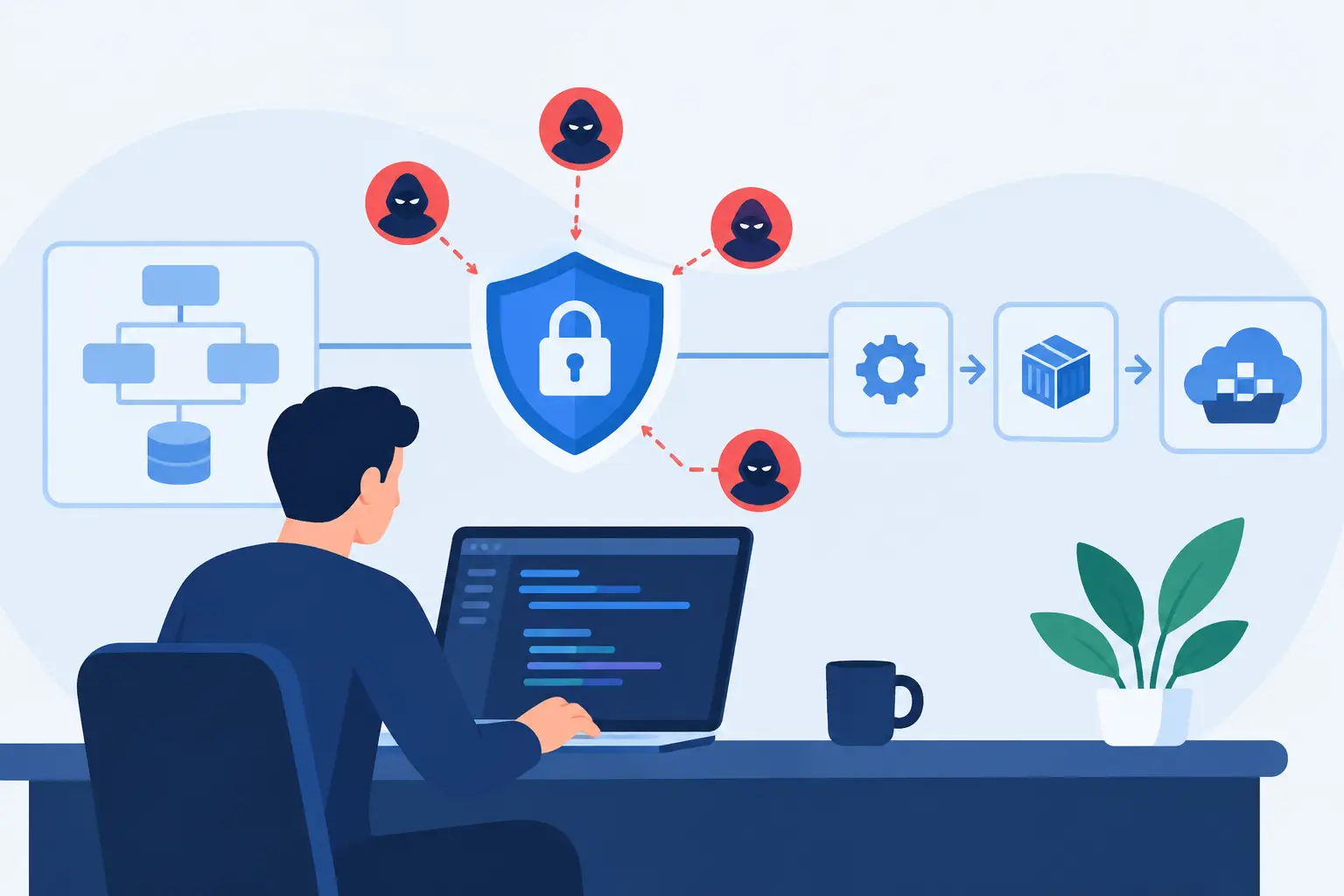
A new endpoint, third-party integration, or background worker can change an application’s attack surface more than a large refactor. The issue is rarely that developers do not care about security. It is that security-relevant assumptions are often made in tickets, pull requests, and deployment configurations without being stated or tested. Threat modeling for developers makes those assumptions visible while the team can still change the design cheaply.
The goal is not to predict every attack. It is to identify the paths that matter, decide which controls are proportionate, and assign ownership before risk reaches production. Done well, threat modeling is an engineering practice, not a compliance ceremony.
Why Threat Modeling Belongs in Development
Security findings discovered late are expensive because they arrive after architectural choices have hardened. A penetration test may identify an authorization bypass, but the underlying cause can be a data model that never represented tenant boundaries correctly. A vulnerability scanner may flag a public storage bucket, but the deeper problem is an infrastructure pattern with no safe default.
Developers are closest to the decisions that create these conditions: where trust boundaries sit, how services authenticate, which data crosses a queue, and whether a client-controlled value is treated as authoritative. Threat modeling gives teams a disciplined way to examine those decisions before they become operational debt.
It also improves communication. Product managers can explain why a feature needs an approval state. Platform engineers can identify where network policy or workload identity is required. Security teams can focus review time on material risk rather than applying the same scrutiny to every low-impact change.
The trade-off is time. A 45-minute model is not justified for a copy change with no new data flow. It is justified for a feature that adds payment data, cross-tenant access, privileged actions, file uploads, external webhooks, or a new identity provider. The depth should match the change.
Start With the System, Not a Threat List
A useful session starts with a simple architecture view. It does not need polished diagrams. Sketch the user, browser or client, API gateway, services, databases, object storage, queues, administrators, and external providers. Then draw the data flows between them.
For each flow, answer three questions: what data moves, who or what initiates it, and what validates it? Add trust boundaries wherever control changes. A browser to an API is one boundary. A workload in your cloud account calling a SaaS provider is another. A support engineer accessing an administrative console is often a particularly sensitive one.
This exercise exposes ambiguity quickly. If a service accepts a callback from a billing provider, where is the signature verified? If a worker receives a job from a queue, does it re-authorize the requested operation or trust the producer? If a customer uploads a file, can that file later be rendered in another customer’s browser?
A diagram should describe reality, including awkward exceptions. Do not omit a legacy admin path, a manually managed API key, or the spreadsheet someone uses to exchange credentials with a client. Those are often the highest-risk parts of the system.
A Practical Threat Modeling Workflow for Developers
Use a lightweight workflow that fits planning and delivery rather than creating a separate security project.
Define the security objective
State what must remain true after the change. For example: only members of an organization can read its invoices; a webhook cannot create a fraudulent fulfillment event; uploaded documents cannot execute active content; production secrets cannot appear in logs or tickets.
Clear objectives are more useful than generic statements such as “secure the API.” They make design decisions testable and clarify which failure would actually harm customers or the business.
Enumerate realistic abuse paths
Walk each data flow and ask how an attacker, malicious tenant, compromised account, or accidental internal actor could misuse it. A practical set of prompts covers spoofing identity, modifying data, accessing data without authorization, exhausting resources, and gaining elevated capability.
Do not stop at external attackers. Many incidents begin with valid credentials used from the wrong context. Consider a developer token exposed in CI logs, a support role with overly broad production access, or a partner integration that sends valid but replayed requests.
Write threats in plain language. “An authenticated user changes the organization ID in a request and retrieves another tenant’s report” is actionable. “Broken access control” is a category, not a finding.
Prioritize by impact and feasibility
Not every theoretical scenario deserves the same response. Rate impact based on the affected data, scope of access, recovery cost, and regulatory or contractual exposure. Then consider feasibility: required access, attacker skill, preconditions, and available detection.
A low-likelihood event may still require action if it can expose a complete customer dataset. Conversely, a nuisance-rate-limit concern may be accepted temporarily if the endpoint has no sensitive effect and strong monitoring. Record the rationale. Risk acceptance without an owner and review date is simply forgotten work.
Choose controls at the right layer
Controls should address the cause, not just the observed symptom. If an API trusts a tenant ID submitted by the client, hiding the field in the UI is not a control. Resolve the tenant from the authenticated identity and enforce authorization in the service layer.
Prefer designs that make unsafe behavior difficult. Use short-lived workload identities instead of long-lived cloud keys. Verify webhook signatures and enforce replay windows. Generate server-side object names rather than allowing path selection. Apply quotas before expensive work begins. Keep sensitive values out of logs by default.
For secret collection and transfer, email, chat, and ticket comments should not be part of the intended control set. Securitae provides account-free Secure Links for collecting credentials from clients, with encrypted storage and options such as burn-on-view or synchronization to a controlled vault. The design decision matters as much as the tool: a secret should have a defined destination, owner, retention period, and revocation path.
Turn outcomes into engineering work
A threat model only changes risk when its decisions enter the delivery process. Convert mitigations into acceptance criteria, implementation tasks, infrastructure changes, and tests. Assign an owner and a deadline for any risk intentionally deferred.
Good examples are specific: add organization-scoped authorization tests for every report route; reject webhook events outside a five-minute timestamp window; restrict the upload processor role to one bucket prefix; redact authorization headers in application and proxy logs. These outcomes can be reviewed in code and verified after deployment.
Common Failure Modes
The most common failure is treating the exercise as a one-time document. Architecture changes continuously. New integrations, permissions, endpoints, and deployment patterns can invalidate an earlier model. Revisit it when a change crosses a trust boundary, handles a new data type, adds privileged functionality, or materially changes scale.
Another failure is modeling only technical components while ignoring operations. Recovery flows, support tooling, CI/CD permissions, break-glass access, and audit-log access deserve the same attention as public APIs. An attacker does not care whether the weak point was labeled “application” or “operations.”
Teams also overproduce artifacts. A detailed threat catalog is less valuable than a concise record of the system, the material risks, the selected controls, and unresolved decisions. Keep the model near the design or repository where engineers will encounter it during future work.
Make It a Habit, Not a Gate
The most effective cadence is small and event-driven. Add a threat-model prompt to design reviews for high-risk changes. Ask reviewers to identify data flows and trust boundaries in architecture pull requests. Reserve deeper sessions for new products, major integrations, or incidents that reveal a systemic weakness.
Security teams should enable this practice with templates, examples, and consultation, but developers must retain ownership of design decisions. Central approval can identify obvious gaps, yet it cannot replace the context held by the engineers building the system.
A useful model does not prove that software is secure. It gives the team a sharper question before release: what are we trusting here, and what happens if that trust is wrong?