
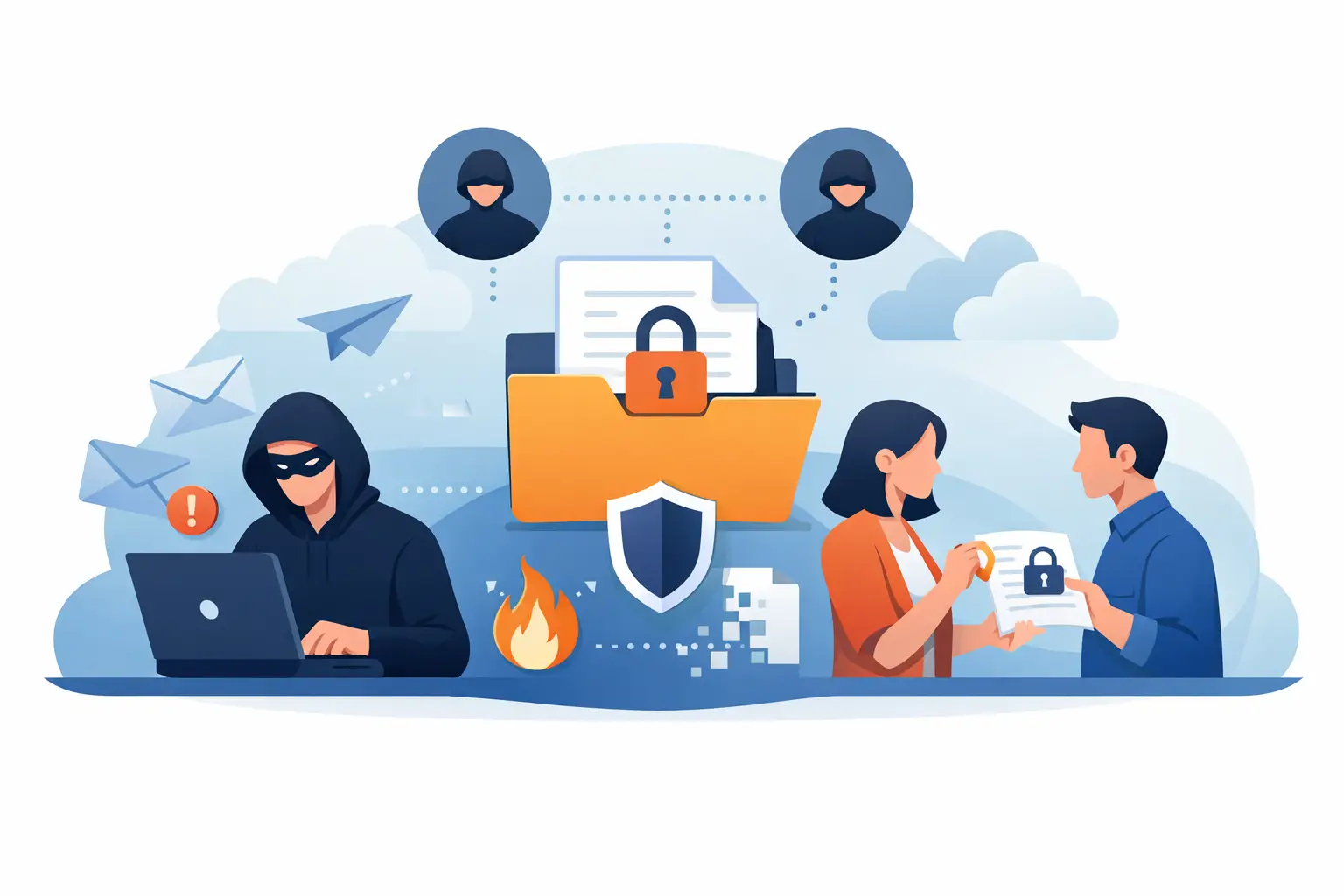
A customer needs to send a production API key. The usual response is predictable: paste it into email, Slack, a ticket, or a shared document. Each choice creates another durable copy, another access path, and another incident-response question. No signup secret sharing is designed to remove that friction without turning credential delivery into an uncontrolled data trail.
For technical teams, the value is not simply convenience. It is the ability to collect and distribute secrets through a purpose-built channel while keeping clients, vendors, and temporary collaborators out of a new account-creation flow. That reduces abandonment at the exact moment secure behavior matters most.
What no signup secret sharing should solve
A no-signup workflow lets a sender create a protected request or secret link and lets the recipient submit or retrieve sensitive information without registering for a service. It is particularly useful when the recipient is outside your identity boundary: a new client, implementation partner, contractor, agency, or vendor contact.
The workflow should replace unsafe habits, not make them slightly more convenient. A secure collection link can ask a client for database credentials, an SSH key, a license file, or an API token without asking them to learn a new product first. The submitted value should then move into an approved destination such as a dedicated vault, password manager, or controlled internal workflow.
This solves a common operational contradiction. Security teams ask people not to send secrets through communication tools, while delivery teams need those secrets immediately to configure environments, investigate issues, or complete onboarding. If the secure alternative is slower than email, people will bypass it.
The security controls that separate a tool from a link
A secret-sharing page is not secure merely because it uses HTTPS. Transport encryption protects data in transit, but a serious workflow must control how data is stored, viewed, retained, and routed after submission.
At minimum, assess the encryption model. AES-256-GCM is a strong authenticated encryption standard for protecting stored secret material. Authentication matters because it helps detect unauthorized modification alongside maintaining confidentiality. Teams should also understand where encryption keys are managed, who can access plaintext, and whether administrative access is constrained and logged.
Expiration is equally important. A link intended for a one-time credential handoff should not remain usable indefinitely. Time limits reduce the chance that a forwarded, forgotten, or exposed URL stays valuable weeks later. For especially sensitive data, burn-on-view behavior is stronger: the secret is deleted after a successful retrieval, limiting exposure to a single access event.
Access controls deserve the same scrutiny. A no-signup recipient experience does not mean the sender should lose control. The sender should be able to set expiration, revoke access, determine whether a secret can be viewed once or persistently stored, and organize links by client, project, or environment. For internal users, role-based permissions and strong authentication remain necessary.
Finally, consider auditability. Security and engineering leaders need to answer practical questions after the fact: Who created the link? When was it accessed? Was it submitted successfully? Did it expire or get revoked? Audit data should expose operational events without recording the secret itself.
When no-signup access is the right trade-off
No-signup secret sharing deliberately lowers identity assurance for external participants. That is often reasonable, but it is not universally appropriate.
It works well when the main risk is accidental disclosure through routine communication channels and the recipient needs a low-friction way to send data. Client onboarding is the clearest example. A professional services team may need access to a cloud account, DNS provider, or third-party API before work can begin. Requiring the client to create and maintain an account in another system adds friction with limited security benefit for a one-time exchange.
It is less appropriate when the workflow requires strong proof of recipient identity, repeated access, privileged production administration, or regulated approval steps. In those cases, federated identity, verified user accounts, just-in-time access, and formal privileged access management may be better controls. A secure link is a credential transfer mechanism, not a replacement for an identity program.
The right question is not whether accountless sharing is inherently safe. It is whether the control set matches the data sensitivity, recipient relationship, access duration, and operational consequence of compromise.
Design the workflow around the secret lifecycle
The most effective implementations treat secrets as short-lived operational objects rather than files to be passed around. Start by identifying the secret type and its destination. A client-submitted API key may need to synchronize directly into a project vault. A temporary recovery code may be viewed once and destroyed. A vendor credential used across an engagement may require persistent, organized storage with owner and access records.
Then define the handling path before sending the link. If the secret will end up in 1Password, Slack, or a dedicated vault, automate that path where possible. Manual copy-and-paste introduces opportunities for clipboard exposure, transcription errors, and accidental placement in tickets or chat history. Integration does not eliminate risk, but it reduces the number of systems and people that touch plaintext.
Bridge-mode designs can reduce local retention further. After successful synchronization to the intended destination, the platform deletes its local copy. This approach is useful for teams that need a secure intake channel but do not want another persistent secret repository. The trade-off is recoverability: if a secret is deleted after synchronization, teams must trust the destination system and have a clear process for failed or disputed transfers.
Environment separation should be explicit. Do not let a collection link for development credentials become a convenient place to submit production access. Use clear labels, separate folders or vaults, and a naming convention that makes ownership and environment obvious. Confusion between staging and production is an operational problem with security consequences.
Common failures that preserve the risk
The most frequent failure is treating a secure link as permission to share a permanent, overprivileged credential. A link can reduce delivery risk, but it cannot make an unnecessarily powerful API token safe. Issue scoped credentials, use short expirations where the platform supports them, and rotate secrets after external sharing when feasible.
Another failure is sending the secret link and its access context through the same exposed channel. If a link is protected by a passphrase or verification code, communicate that second factor through a different channel. Otherwise, a compromised inbox or chat account may provide both pieces needed for access.
Teams also overlook link forwarding. A recipient may send the URL to a colleague for convenience, or a ticket system may capture it in an email notification. Short expiry, single-use retrieval, revocation, and access event logging limit the damage. Clear instructions matter as well: tell recipients that the link contains sensitive material and should not be forwarded or copied into tickets.
Finally, do not ignore the endpoint. A secret-sharing service can protect data in transit and at rest, but it cannot fully protect a compromised recipient device, a browser extension with broad permissions, or an unmanaged workstation. High-risk exchanges may require additional procedural controls, including verified contacts, managed devices, and immediate credential rotation after use.
A practical standard for engineering teams
A defensible no-signup secret-sharing process is simple enough for a client to use correctly and controlled enough for security teams to govern. It should provide authenticated encryption, configurable expiry, burn-on-view options, revocation, event visibility, and a defined destination for every collected secret. It should also support the realities of modern operations: external parties, fast-moving launches, infrastructure handoffs, and teams that cannot wait for account provisioning.
Securitae is built around that operational gap, providing Secure Links for accountless credential collection alongside encrypted storage, folder organization, API access, and synchronization to approved destinations. The goal is not to create another place where credentials linger. It is to give teams a safer path from external submission to controlled storage.
The strongest improvement is often a small behavioral one: make the secure option the fastest option. When clients can submit a secret in seconds, engineers can route it to the right vault, and access disappears when it is no longer needed, email stops being the default system for handling credentials.