
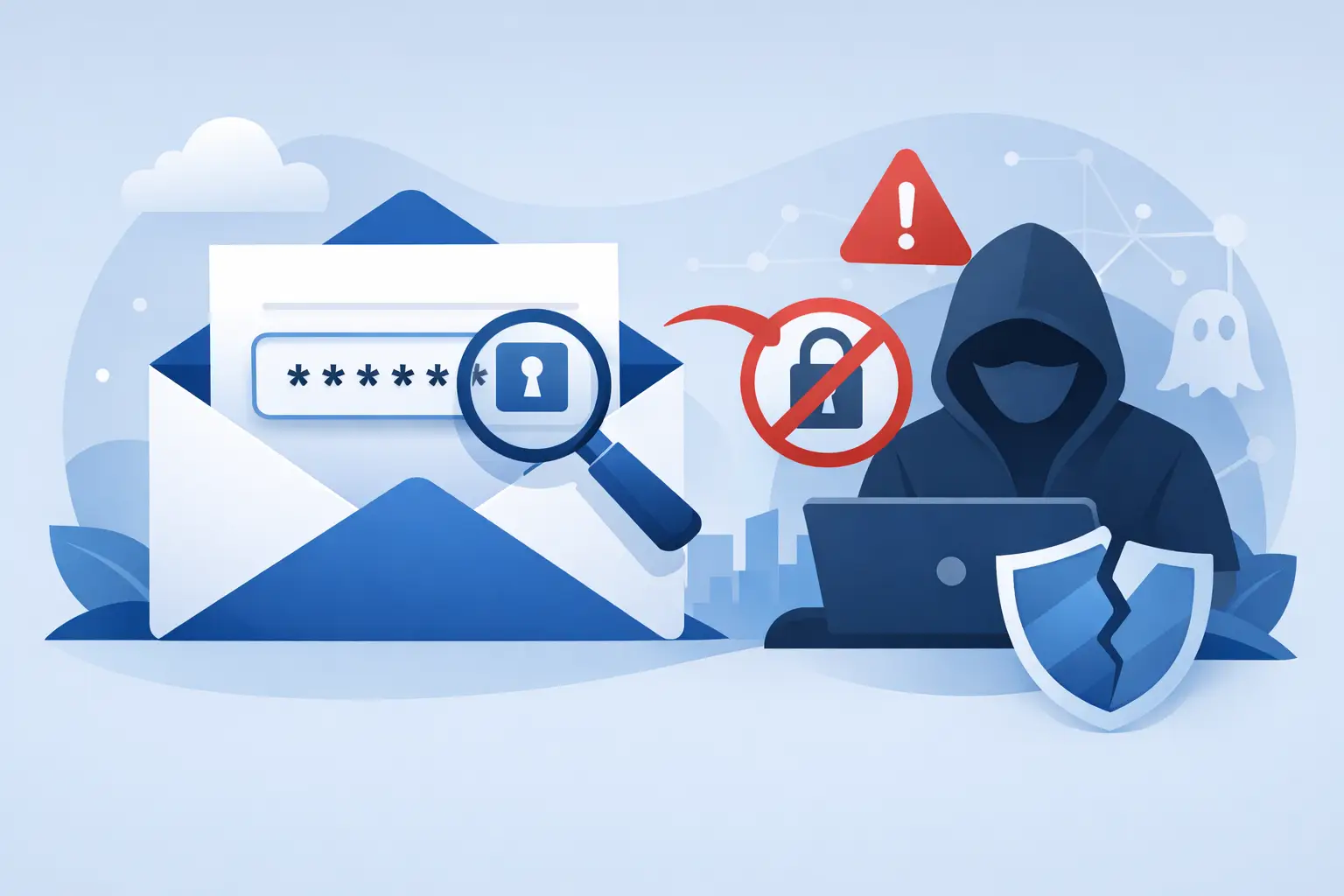
A client sends a production database password by email, then replies-all with the MFA backup codes an hour later. Nobody planned to create a security incident. It just happened because email is still the default tool for moving sensitive information. If you are asking is email safe for passwords, the short answer is no in most business environments.
That answer needs nuance. Email is not a single system with uniform security properties. It is a chain of clients, servers, archives, forwarding rules, mobile devices, browser sessions, backup systems, and human habits. A password sent by email does not just travel from sender to recipient. It tends to persist across multiple systems, often far beyond the moment it was needed.
Is email safe for passwords in practice?
For most organizations, email is a poor channel for passwords, API keys, recovery codes, and other secrets. The main issue is not only transport encryption. Many teams hear that their provider uses TLS and assume the problem is solved. It is not.
TLS may protect email while it is moving between some servers, but it does not control what happens before or after transit. Secrets can remain in sent folders, inboxes, search indexes, device caches, mailbox exports, journaling systems, SIEM pipelines, and third-party backup platforms. If a mailbox is compromised six months later, an attacker may find credentials that were only meant to exist for five minutes.
This is the core problem with email for password sharing: persistence. Passwords are supposed to be tightly controlled and short-lived in exposure. Email creates broad, durable copies by design.
Why email creates unnecessary credential risk
The first risk is mailbox compromise. Email accounts are high-value targets because they are often the root of identity recovery. If an attacker gets access to one inbox, they can search years of messages for terms like password, credential, key, secret, VPN, or admin. That is efficient privilege escalation.
The second risk is misdelivery. Email makes it easy to send a password to the wrong person, include the wrong distribution list, or let autocomplete choose the wrong address. Once sent, there is no reliable recall. Even if your platform offers a recall feature, it is inconsistent across clients and does not eliminate downstream copies.
The third risk is forwarding and rule sprawl. Many users forward mail between accounts or set rules that copy messages into shared folders, ticketing systems, or chat integrations. A password intended for one recipient can quietly propagate to systems that were never part of the approval path.
The fourth risk is retention. Security teams spend a lot of effort reducing secret exposure in code, logs, and infrastructure. Email often gets excluded from that discipline. Yet mail retention policies, legal holds, endpoint backups, and eDiscovery systems can preserve passwords long after rotation windows should have invalidated them.
There is also the issue of auditability. Email tells you that a message was sent. It does not give you strong control over who viewed a secret, whether it was copied, whether it expired, or whether it was accessed from an unmanaged device. For operational security, that is weak telemetry.
But what about encrypted email?
Encrypted email is better than plain email, but it still does not make email ideal for passwords. End-to-end encryption reduces exposure in transit and on some intermediary systems, but it does not remove the basic persistence problem. Once the recipient decrypts the message, the secret can still be stored locally, captured in backups, screenshotted, forwarded, or synced to other devices.
This is where teams often confuse confidentiality with containment. A password needs both. Confidentiality means unauthorized parties should not read it. Containment means even authorized handling should be narrow, time-bound, and difficult to reproduce casually. Email struggles with containment.
If both parties use a mature encrypted email workflow, have hardened endpoints, enforce mailbox protection, and control retention tightly, the risk is lower. Even then, it is usually not the best pattern for credential exchange. Lower risk is not the same as appropriate risk.
When email might be acceptable
There are edge cases where email is tolerable, but they are narrower than most teams assume. For example, if the password is temporary, low privilege, immediately rotated after first use, and sent inside a tightly managed environment with strong mailbox protections, the exposure may be acceptable relative to the business need.
That does not make email safe. It means the blast radius is constrained enough that the organization can absorb the risk.
A common example is a one-time onboarding credential for a low-sensitivity internal system, where the user is forced to reset on first login and the account has no privileged access. Even there, many organizations split the information across channels, such as username by email and temporary password by voice or secure delivery tool.
High-impact credentials should not be sent by email. That includes production access, database passwords, root credentials, cloud console logins, private keys, recovery codes, API tokens, and anything that can pivot into broader infrastructure.
What to use instead of email
The right replacement is a purpose-built secret-sharing workflow. That means the secret is encrypted, access is controlled, exposure is limited, and retention is intentional rather than accidental.
The strongest pattern is a secure link that allows a password or key to be submitted or shared without creating a permanent artifact in email. Ideally, the recipient accesses the secret through a link with expiration controls, optional burn-on-view behavior, and a clean audit trail. Better still if the secret can move directly into a password manager or vault instead of sitting in human inboxes.
This matters for external collaboration. Vendors, clients, and contractors rarely share your internal tooling. Telling them to use your enterprise password manager is not always realistic. A secure collection or transfer mechanism removes that friction while keeping the credential out of email.
For teams that regularly collect secrets from third parties, a platform such as Securitae can reduce that exposure materially. It allows secure links for password and API key submission without requiring account creation from the sender, and it supports workflows like burn-on-view and vault synchronization. That is a better fit for modern engineering operations than letting secrets accumulate in mailboxes.
How to decide if your current process is acceptable
Ask a few direct questions. Does the secret remain searchable in an inbox after it has served its purpose? Can it be forwarded or copied without control? Would a compromised mailbox expose privileged systems? Does the process create duplicate copies across endpoints or backups? If the answer to any of these is yes, the process is weak.
Also consider frequency. A one-off exception is different from a standing habit. If your team regularly exchanges credentials by email, you do not have an exception. You have an unmanaged secret distribution channel.
This is where technical leadership matters. CTOs, security leaders, and DevOps teams should treat email-based password sharing as a process flaw, not just a user mistake. If people keep using email for secrets, it usually means the safer path is too slow, too fragmented, or too hard for external parties. Security controls that add friction without solving usability tend to fail quietly.
A better standard for password handling
The standard should be simple. Passwords and other secrets should be shared only through mechanisms designed for secrets, with limited exposure windows, strong encryption, controlled retrieval, and clear lifecycle handling. Email does not meet that standard consistently.
The practical goal is not perfection. It is reducing the number of places a credential can linger and reducing the number of systems that can expose it later. That is how you lower operational risk without slowing delivery.
If a secret matters enough to protect inside your application, cloud environment, or CI pipeline, it matters enough not to send through a medium built for permanence and convenience. The safest password is not the one hidden in a long email thread. It is the one that was never there in the first place.