
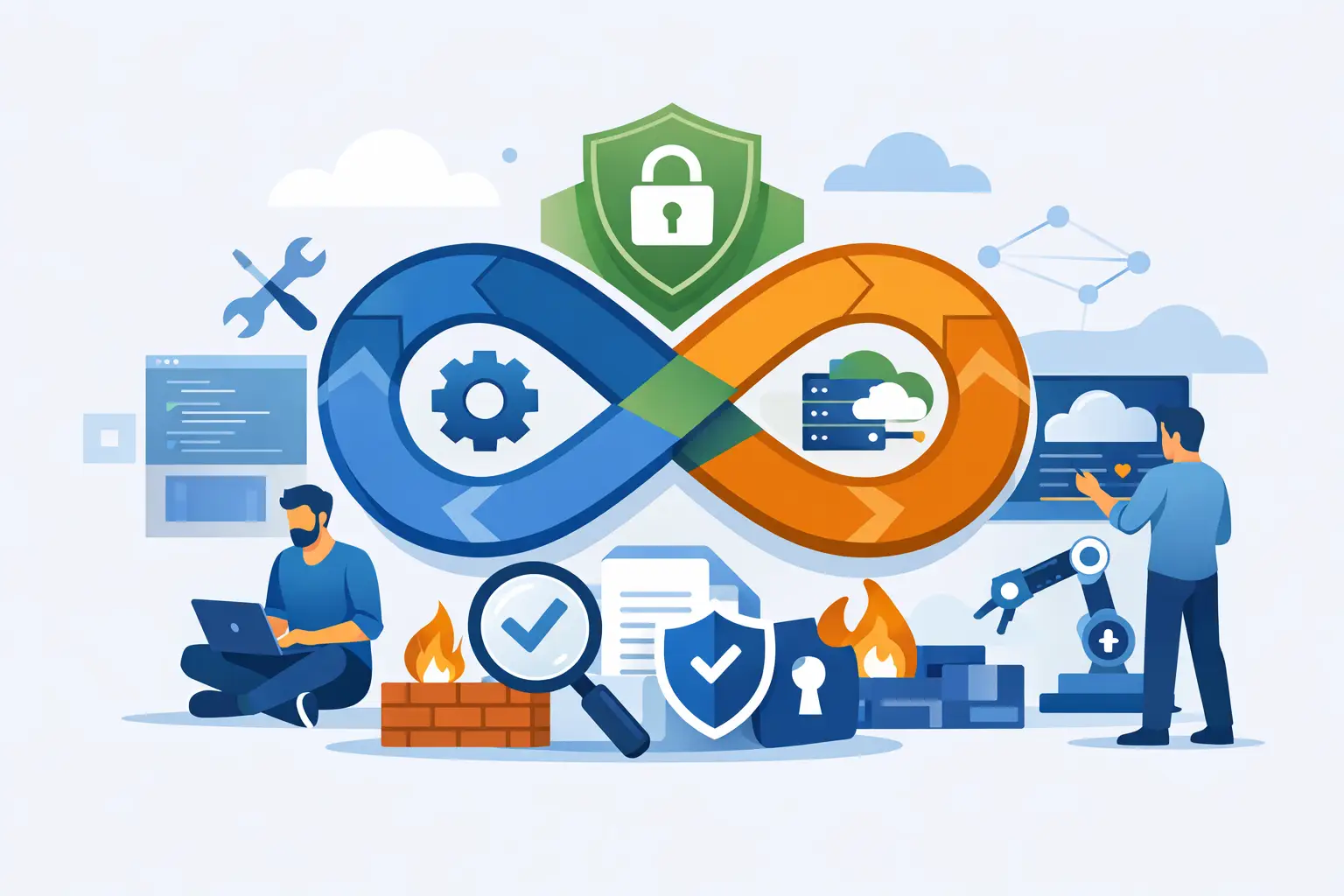
Most DevSecOps programs fail for a simple reason: they add security controls to the pipeline without changing how teams build, ship, and own software. If you are asking how to implement DevSecOps, the real question is how to make security part of delivery without creating another approval layer that engineering learns to route around.
That starts by treating DevSecOps as an operating model, not a tool purchase. The goal is not to maximize scans. It is to reduce exploitable risk while preserving release speed, developer trust, and operational clarity.
How to implement DevSecOps without slowing delivery
The fastest way to derail adoption is to begin with a long list of security tools and no agreement on ownership. Mature teams start smaller. They define what must be protected, where risk enters the software lifecycle, and which controls belong inside engineering workflows versus outside them.
In practical terms, that means aligning security requirements to the way software is actually delivered. A startup shipping to production ten times a day needs different controls than a regulated enterprise with change advisory boards. The principles are consistent, but enforcement points, escalation paths, and evidence requirements vary.
The first implementation decision is organizational. Security should set guardrails, build reusable controls, and monitor exceptions. Engineering should own remediation in code, infrastructure, and pipelines. Platform teams often sit in the middle, turning policy into paved roads that teams can adopt without friction.
Start with architecture, ownership, and risk
Before introducing automation, map the application and infrastructure landscape. Identify critical services, internet-facing assets, data stores, CI/CD systems, cloud accounts, and secret flows. Many teams underestimate the last category. Credentials, tokens, certificates, and API keys move through chat, tickets, build logs, deployment variables, and third-party handoffs more often than anyone expects.
This is where early DevSecOps work pays off. If your secret handling is informal, every later control becomes weaker. A secure delivery model depends on knowing who can create, access, rotate, and revoke sensitive material. That includes developer credentials, machine identities, deployment secrets, and anything shared with vendors or clients.
Next, define ownership at the service level. Every application should have a clear engineering owner, a deployment path, a data classification, and a minimal security baseline. Without that, vulnerabilities remain untriaged, findings age out, and exceptions become permanent.
Build security into the SDLC, not beside it
Teams often ask where security checks should sit. The better question is where a given issue can be fixed most cheaply. DevSecOps works when controls move as far left as they can without generating noise that teams ignore.
At the planning stage, add lightweight threat modeling for material changes. This does not need to be a workshop every sprint. For high-risk services, it can be as simple as documenting trust boundaries, authentication paths, sensitive data handling, and external dependencies before implementation begins.
During coding, establish baseline controls in developer environments. Pre-commit checks, secure coding standards, branch protections, and repository rules catch preventable issues early. Secret scanning belongs here, especially for organizations with fast-moving teams and multiple integration points.
In CI, focus on automated checks that produce actionable findings. Common examples include static analysis, software composition analysis, infrastructure-as-code scanning, container image scanning, and policy checks for build artifacts. The mistake is enabling every rule on day one. Start with high-confidence checks tied to real exploit paths, then tighten coverage over time.
At deployment, enforce environment-specific controls. Production releases should validate artifact provenance, configuration policy, and runtime security requirements. Lower environments can be more permissive if they are isolated and use nonproduction data. Not every control must block. Some should alert, some should require exception review, and a few should be hard gates.
Tooling strategy matters less than workflow design
Security leaders often overestimate the importance of picking the perfect stack. Tool quality matters, but workflow fit matters more. If findings cannot be routed to the right team, prioritized against delivery work, and measured over time, the tool will become shelfware.
A sound DevSecOps tooling model usually covers code, dependencies, infrastructure, containers, cloud posture, runtime telemetry, and secrets. What matters is integration. Findings should land where developers already work, ideally in pull requests, issue trackers, and deployment dashboards rather than a separate security portal that few people check.
Normalization is also important. If one pipeline reports a critical dependency issue, another flags the same package as high, and a third suppresses it entirely, teams lose confidence. Establish a shared severity model and a consistent triage process.
This is also where secrets deserve special attention. Credentials are one of the few issue categories that can move from minor hygiene problem to active incident in minutes. Teams implementing DevSecOps should standardize how secrets are collected, shared, synced to vaults, and destroyed after use. For external collection and short-lived handling, a platform such as Securitae can reduce exposure by replacing ad hoc email and chat workflows with encrypted secure links and burn-on-view delivery at securitae.dev.
Make policy enforceable and narrow
Policy is necessary, but long policy documents do not secure software. Teams need short, testable requirements that can be translated into code and pipeline logic. Good examples include branch protection for protected repositories, mandatory secret scanning on pull requests, signed artifacts for production, and defined remediation windows for exploitable vulnerabilities.
The narrower the requirement, the easier it is to automate. The broader the requirement, the more likely it becomes theater. “All applications must be secure” is meaningless. “Internet-facing services must enforce MFA for administrative access and rotate deployment credentials every 90 days” is enforceable.
Trade-offs matter here. Hard gates are effective for high-confidence, high-impact failures. They are less effective when scanners produce false positives or when remediation requires architectural change. If you block every build on low-context findings, teams will spend energy fighting the control instead of reducing risk.
Measure behavior, not scanner volume
A mature DevSecOps program is visible in engineering metrics. You should know how quickly exploitable findings are fixed, how many production repositories have baseline controls enabled, how often secrets are exposed in source control, and how many exceptions remain open past expiration.
Avoid vanity metrics. Counting total findings across tools says very little. A growing organization with better coverage may show more findings while becoming safer. More useful indicators include mean time to remediate by severity, percentage of builds with policy pass rates, secret rotation compliance, and reduction in recurring misconfigurations.
It is also worth tracking where issues are caught. If the same class of problem keeps appearing in production or pre-release testing, move the control earlier. That is one of the clearest ways to tell whether DevSecOps is actually improving the system.
How to implement DevSecOps across teams
Rolling out DevSecOps across multiple teams requires pacing. Start with one or two services that are important enough to matter but not so fragile that any process change becomes political. Build the first version of your guardrails there, document what worked, and then standardize the pattern.
Champions can help, but they are not a substitute for platform support. A security champion without good tooling becomes an unpaid translator between two frustrated teams. A champion with reusable templates, clear exception paths, and service-level baselines can accelerate adoption.
Training should be specific to team responsibilities. Developers need secure coding guidance tied to their language and framework. Platform teams need policy-as-code, identity, and infrastructure hardening depth. Engineering leaders need risk reporting that connects directly to delivery decisions. Keep it practical. A one-hour session on real issues from your own environment usually outperforms generic awareness content.
Common implementation mistakes
The most common mistake is trying to centralize every decision in the security team. That creates queues and weakens accountability. The second is turning on too many checks too quickly. High-noise environments teach developers to ignore alerts. The third is neglecting secrets and machine identity. Teams often secure code and containers while deployment tokens remain broadly shared and poorly rotated.
Another frequent failure is treating exceptions as permanent. Every exception should have an owner, rationale, expiration date, and review path. Without that, temporary risk acceptance becomes policy by drift.
The final mistake is assuming compliance equals security. Framework alignment can help structure a program, but audit evidence does not guarantee exploit resistance. DevSecOps should improve real engineering decisions, not just documentation quality.
A credible DevSecOps implementation feels almost boring after a while. Developers know what is expected. Pipelines catch the issues they should catch. Security has visibility without becoming a bottleneck. Secrets stop moving through unsafe channels. That is the standard to aim for – not maximum tooling, but minimum unnecessary risk with delivery still intact.
If you are building the program from scratch, begin where exposure is highest and process discipline is weakest. That is usually where the best security gains are still available.