
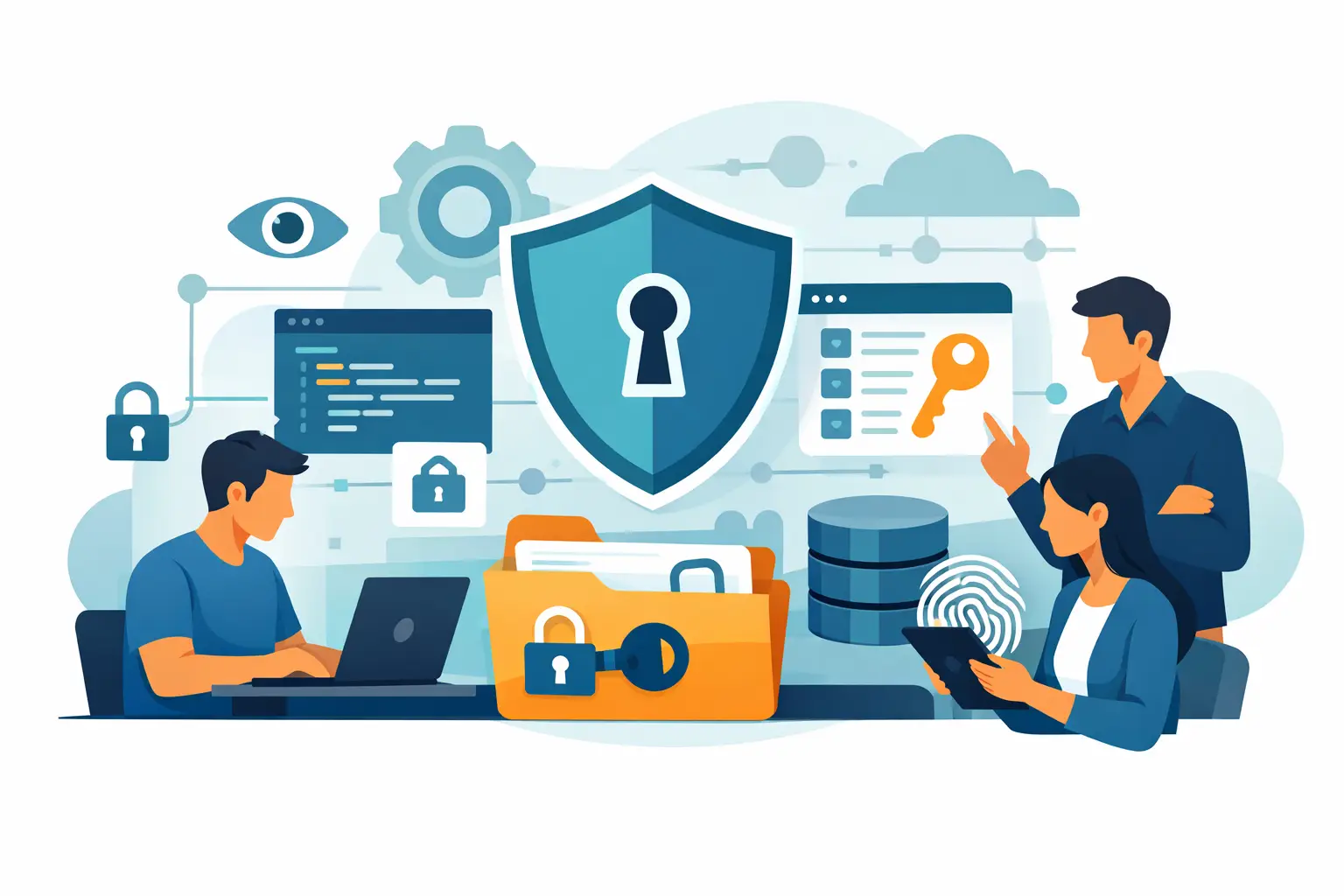
A production credential rarely leaks because an engineer intended to expose it. It leaks because a private key was pasted into a ticket, a database password traveled in a direct message, or a `.env` file made its way into a repository and then into a build artifact. This developer secrets management guide focuses on preventing those ordinary failures without slowing engineering delivery.
Secrets management is not just a vault selection exercise. It is the operating model for how credentials are created, stored, shared, rotated, observed, and revoked across people, services, and environments. If any part of that model depends on memory, informal chat, or long-lived credentials, the organization has a material security gap.
Define what counts as a secret
Teams often protect production database passwords while overlooking the credentials that make a breach easier to execute. A secret is any value that grants access, proves identity, decrypts protected data, or enables a privileged action. That includes API keys, cloud access keys, SSH keys, signing certificates, session secrets, OAuth client secrets, webhook tokens, encryption keys, and infrastructure credentials.
A useful test is simple: if someone who should not have the value obtained it, could they access a system, impersonate a user, alter data, or expand their access? If the answer is yes, treat it as a secret.
Classify secrets by both sensitivity and operational use. A short-lived staging token is not equivalent to a production signing key, but both still need controlled handling. Classification determines where the secret can be used, who can retrieve it, how quickly it must be rotated, and what alerting is required.
Remove secrets from source code and configuration history
The first control is non-negotiable: secrets do not belong in source code. They should not live in committed environment files, container images, IaC variables checked into version control, mobile application bundles, or CI configuration stored as plaintext.
This rule applies to private repositories as well. Repository access changes over time. Forks, cloned workstations, CI logs, backups, contractor access, and accidental exposure all expand the attack surface. Once a credential enters Git history, removing the visible line is not enough. The value may remain in prior commits, pull-request diffs, build logs, caches, and developer machines.
Use pre-commit detection to catch obvious mistakes before they leave a workstation, then scan repositories and build outputs continuously. Detection tools reduce exposure, but they are not a substitute for a safer design. The target state is for applications to retrieve secrets at runtime from an approved system, using an identity that is itself tightly scoped.
When a secret is committed, assume it is compromised. Revoke or rotate it immediately, investigate where it propagated, and document the root cause. Rewriting history may reduce future discovery, but it does not restore trust in the old credential.
Build a secret lifecycle, not a storage closet
A secret manager provides value only when it supports a complete lifecycle. Engineering and security teams should be able to answer four questions for every high-value credential: who owns it, where is it used, who can read it, and when was it last rotated?
The lifecycle begins with generation. Create high-entropy values through approved tooling rather than choosing reusable passwords or inventing API tokens by hand. Store the secret in a centralized, access-controlled system and attach enough metadata to make it manageable: owner, service, environment, creation date, rotation expectation, and incident contact.
Distribution should be automated where possible. A workload in a cloud environment should authenticate through workload identity, an instance role, or a comparable short-lived identity mechanism. It should retrieve only the values needed for its function and environment. A development service should not be able to read production credentials merely because both values are stored in the same platform.
Rotation is where many programs fail. Rotation that exists only as a policy is delayed until an incident or audit. Start with the credentials that create the greatest blast radius: cloud root or administrative access, production databases, deployment keys, payment systems, and customer-data integrations. Automate rotation where the provider supports it. For the rest, establish an owner, a tested procedure, and a deadline.
Revocation must be equally deliberate. Disable credentials when employees leave, vendors complete an engagement, a service is decommissioned, or suspicious activity appears. Persistent access without a current business need is not operational convenience. It is unmeasured risk.
Apply least privilege to humans and workloads
Centralized storage does not automatically produce least privilege. A vault that grants every engineer access to every production secret is simply a better-organized exposure point.
Use separate environments, separate access policies, and separate service identities. Developers may need controlled access to development and test credentials. Production access should be limited, time-bound where feasible, and attributable to a named identity. Break-glass access can be appropriate for incident response, but it should require elevated approval and generate an audit event.
For workloads, avoid broad credentials shared by multiple applications. Give each service its own identity and narrowly scoped permissions. If a compromised application can only read one queue token, the incident is contained. If it can enumerate every secret in a production namespace, the blast radius becomes an organizational problem.
This is also why static secrets are not always the best answer. Dynamic database credentials, short-lived cloud tokens, and signed workload identities reduce the value of a stolen value. They add implementation complexity, however, and not every third-party platform supports them. Prioritize dynamic credentials for systems with privileged access or sensitive data, then improve the rest through disciplined rotation and access control.
Secure the moments when secrets must be shared
The most overlooked risk is not application runtime. It is the human handoff.
A customer may need to send an API key to an implementation team. A contractor may need to provide a certificate. An engineer may need to transfer a credential during an incident. If the default method is email, Slack, a ticket, or a shared document, the secret is likely to persist in systems designed for communication rather than credential custody.
Use a purpose-built collection flow for external submissions and a controlled sharing mechanism for internal handoffs. The sender should not need an account just to submit a credential, and the recipient should receive a clear audit trail without creating another unmanaged copy.
Securitae Secure Links are designed for this specific gap: collecting passwords, API keys, and other sensitive values without requiring client signup. Links can support burn-on-view handling or persistent storage, and collected secrets can sync into approved destinations such as 1Password, Slack, or dedicated vaults. For higher-sensitivity workflows, bridge mode can delete local data after synchronization, reducing residual storage.
The right retention setting depends on the use case. Burn-on-view is appropriate when a secret needs one controlled handoff. Persistent storage may be necessary when an operations team must manage a vendor credential over time. What should not vary is the baseline: do not move secrets through general-purpose communication channels.
Protect secrets in CI/CD and infrastructure automation
CI/CD systems are high-value targets because they often hold deployment access, package registry tokens, cloud credentials, and signing material. Treat pipeline configuration as privileged infrastructure.
Use the CI platform’s protected secret storage only as part of a broader design. Restrict secrets to protected branches and approved environments, prevent them from appearing in logs, and separate build credentials from deployment credentials. A pull request from an untrusted fork should never gain access to production secrets simply because a workflow was misconfigured.
Prefer federated identity between CI and cloud providers instead of long-lived cloud keys stored in pipeline variables. The pipeline should exchange an authenticated job identity for a short-lived, narrowly scoped token. This reduces rotation burden and makes a leaked configuration value less useful to an attacker.
Infrastructure-as-code deserves the same discipline. State files can contain generated passwords, connection strings, and sensitive outputs. Encrypt state, restrict access, avoid printing values in plans or logs, and mark sensitive outputs appropriately. If state is broadly accessible, it can quietly become the organization’s largest secret repository.
Monitor use and rehearse failure
Audit logs should answer who accessed a secret, from where, when, and through which workflow. Review access patterns for production and administrative credentials, especially bulk retrieval, unusual locations, failed access attempts, and use outside change windows.
Logging access is necessary, but teams also need a tested response path. Run a credential compromise exercise: identify the owner, revoke the value, rotate dependent systems, validate service recovery, search for copies, and record lessons. A rotation procedure that has never been tested under pressure is an assumption, not a control.
Start with one high-risk workflow this week. Replace the next credential sent through email or chat with a controlled collection or sharing path, assign an owner, and define its rotation date. Small operational changes are how secrets management becomes part of engineering practice rather than another security policy waiting to be ignored.