
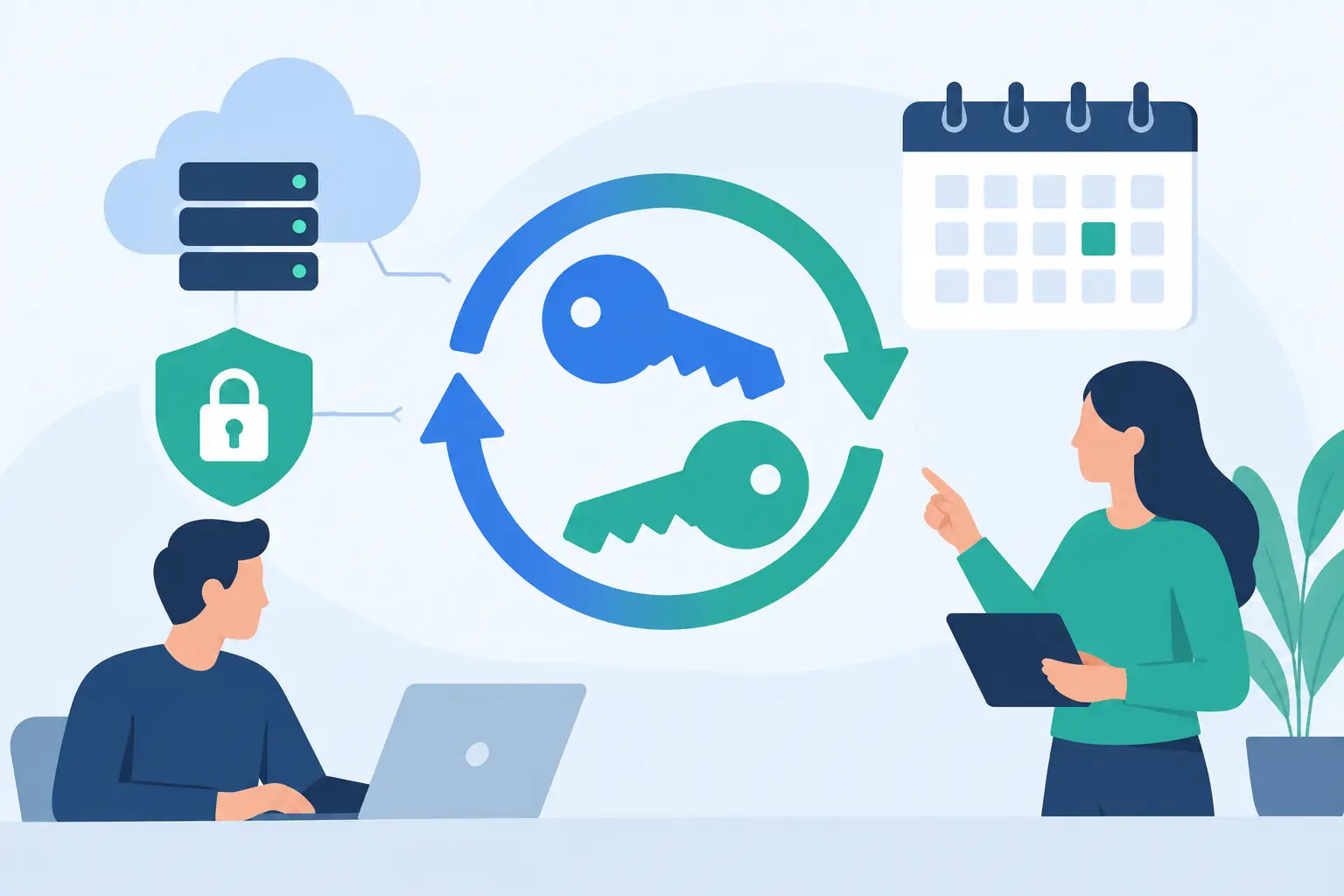
An API key discovered in a source repository, CI log, ticket, or vendor support thread is already a rotation event. The harder question is when should teams rotate API keys that have not visibly leaked. A fixed calendar helps, but it is not a complete control. Rotation policy should reflect what the key can access, where it is stored, how widely it is used, and whether your team can replace it without interrupting production.
For most engineering organizations, the best policy combines scheduled rotation with immediate, event-driven rotation. It also recognizes a more fundamental point: long-lived API keys should be the exception. Where a platform supports short-lived credentials, workload identity, or scoped tokens, use those mechanisms first.
When should teams rotate API keys?
Teams should rotate a key immediately after any suspected exposure, privilege change, employee or vendor offboarding, or unexplained usage anomaly. For keys that remain long-lived, schedule rotation based on risk rather than applying one universal deadline.
A reasonable starting point is 90 days for high-value production keys, 180 days for lower-risk internal integrations, and annual review for tightly controlled keys that cannot be rotated more frequently because of vendor limitations. Those intervals are baselines, not proof of security. A broadly scoped key that can read customer data, provision cloud infrastructure, send email, or move money may need a much shorter lifetime. A narrowly scoped key used by a monitored internal service may justify a longer interval if rotation creates material operational risk.
The key is to distinguish rotation cadence from credential hygiene. A key that is overprivileged, copied across environments, or stored in plaintext remains dangerous even if it changes every 30 days.
Rotate immediately after exposure or suspected exposure
Treat exposure as a containment problem, not a cleanup task. Revoke or rotate the credential as soon as you can safely do so if it appears in public or private source control, build output, application logs, browser code, chat, documentation, issue trackers, backups, screenshots, or an unapproved third-party system.
Do not wait for proof of misuse. API providers may offer access logs, but many do not provide enough visibility to rule out copying or delayed abuse. Preserve relevant evidence, review activity before and after revocation, and determine why the secret reached the unsafe location. The corrective action may include git history remediation, log redaction, scanner rules, and tighter controls over secret distribution.
A key sent through ordinary email or chat should be considered exposed to an uncontrolled retention and forwarding path. Security teams need a purpose-built collection process for external clients, contractors, and vendors. Securitae supports secure links for receiving credentials without requiring the sender to create an account, reducing the common habit of sending secrets through inboxes and messaging tools.
Rotate after access and ownership changes
Credential ownership must outlive individual employees. Rotate keys when the person or team responsible for an integration leaves, changes roles, loses production access, or transfers ownership. The same principle applies to contractors, agencies, managed service providers, and SaaS administrators.
This is not merely an offboarding checkbox. Shared keys often persist because no one can confidently identify every workload that uses them. If offboarding exposes that uncertainty, the immediate task is to map dependencies. The long-term task is to remove shared human-owned credentials from service paths.
Rotate when a key’s permissions expand or when the system it accesses changes classification. For example, a key originally limited to sandbox telemetry may later gain access to production events or customer identifiers. That is a new trust boundary. Issue a new credential with deliberate scopes rather than extending the old one indefinitely.
Rotate after abnormal behavior
Usage anomalies do not always mean compromise, but they deserve investigation and often justify rotation. Examples include calls from unexpected regions or networks, a sudden increase in error rates, access outside a service’s normal deployment window, unexpected API endpoints, or activity from a retired environment.
Detection quality matters here. Centralize provider audit logs where possible and tag credentials by application, environment, owner, and purpose. A key named `prod-key-final` provides almost no value during an incident. A key labeled with its service, environment, vendor, owner, and issuance date gives responders a path to action.
Set rotation intervals by risk, not tradition
A 90-day policy is easy to communicate, but it can become security theater if it causes outages, workarounds, and undocumented exceptions. Use a risk model that considers privilege, data sensitivity, exposure surface, and recoverability.
High-risk credentials generally include cloud provider access keys, payment processor keys, production database integration credentials, administrative SaaS tokens, and keys accepted from internet-facing applications. Rotate them frequently, minimize their scopes, and maintain tested replacement procedures. If a key can alter infrastructure or access regulated data, assume it warrants stronger controls than an analytics key limited to writing anonymous events.
Medium-risk credentials often support production integrations with limited permissions. Rotate these on a defined schedule, usually every three to six months, and require an accountable owner. Low-risk credentials may be limited to local development or nonproduction services with synthetic data. They still need expiration, revocation, and inventory, but their cadence can be less aggressive.
Some provider keys cannot be rotated without service disruption, or the provider permits only one active key. In those cases, document the constraint, reduce the key’s permissions, restrict its network path if supported, and monitor use closely. A compensating control is not the same as accepting the risk. It is a temporary design condition that should be revisited when the vendor offers safer authentication options.
Make rotation a deployment, not an emergency
The safest rotation process supports overlapping credentials. Create a new key, distribute it through approved secret storage, deploy consuming services, verify traffic on the new credential, then revoke the old one after a short validation window. This avoids the familiar failure mode where a key is revoked first and a forgotten worker, cron job, or disaster-recovery process breaks hours later.
The validation window should be deliberately short. Keeping both keys active for weeks doubles the attack surface and obscures whether migration actually completed. For critical systems, use telemetry to confirm that the old credential has stopped receiving requests before revocation.
A mature runbook should answer a few operational questions without requiring improvisation: Who can issue and revoke the credential? Where is the canonical secret stored? Which applications and pipelines consume it? How are deployments triggered? What alerts indicate a failed cutover? Who approves an emergency rotation outside business hours?
Test this process before an incident. A quarterly game day that rotates a noncritical production integration can expose missing inventory, hardcoded secrets, manual deployment dependencies, and vendor-specific limits. Those are the gaps that turn an otherwise routine exposure into a prolonged outage.
Reduce the number of keys worth rotating
Rotation is necessary because static secrets persist. The stronger design is to reduce static secrets wherever possible. Prefer short-lived OAuth tokens, cloud workload identity, federated access, mutual TLS, or service-specific identities that are automatically renewed. These approaches reduce the useful lifetime of a stolen credential and improve attribution.
When static keys are unavoidable, enforce least privilege and environment separation. A development key should never authenticate to production. A single key should not be shared across multiple services simply because it is convenient. Separate credentials make revocation more precise and make audit trails meaningful.
Keep secrets out of source code, container images, client-side applications, and general-purpose collaboration systems. Use a managed secret store, inject credentials at runtime where practical, and prevent secret values from entering logs. Secret scanning in pre-commit hooks, CI pipelines, repositories, and collaboration exports provides a valuable backstop, but it does not replace secure handling at the point a credential is created or received.
Measure whether the policy works
A rotation policy should produce evidence. Track the percentage of active keys with a known owner, age distribution, scope classification, last-used timestamp, and upcoming rotation date. Monitor mean time to revoke after an exposure report and the percentage of rotations completed with no production incident.
Also track exceptions. If the same vendor or internal platform repeatedly requires exceptions, the issue is probably architectural. Engineering leadership should see those patterns because they indicate where investment in identity modernization or integration redesign will reduce risk more effectively than stricter reminders.
The goal is not to make teams rotate credentials as often as possible. It is to make every credential temporary, attributable, narrowly useful, and replaceable under pressure. A key that can be rotated calmly on an ordinary weekday is far less likely to become the deciding factor in an incident.