
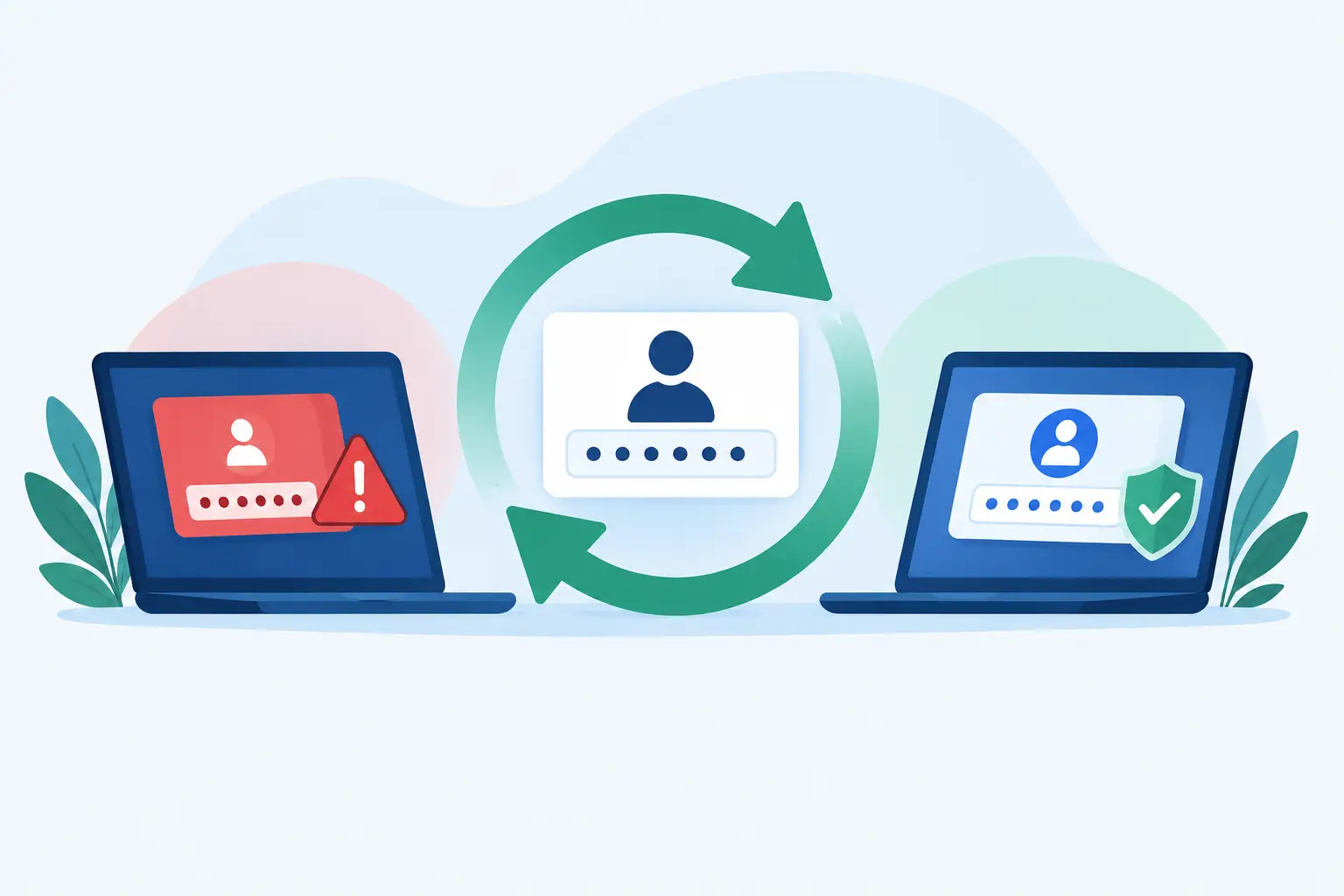
A leaked production credential is not a ticket to handle after the next deployment. It is an active access path until proven otherwise. Whether the exposure came from a public repository, a misconfigured CI log, a vendor handoff, or a developer workstation, the response must remove attacker utility while preserving the systems that still depend on that credential.
Knowing how to rotate compromised credentials is therefore more than generating a new password or API key. It is an incident-response process: scope the exposure, create replacement access, update every dependency, revoke the old secret, and verify that no unauthorized activity persists.
Start by treating the credential as active
Do not wait for evidence of misuse before rotating a credential that was exposed outside its intended trust boundary. An attacker may have copied it immediately, and many cloud, SaaS, and source-control access logs are not complete enough to establish that a key was never used.
First, classify the credential by privilege and blast radius. A read-only analytics token does not demand the same response as a cloud root key, database administrator password, signing certificate, or CI service account capable of deploying production code. But lower-privilege secrets can still support reconnaissance, data aggregation, or lateral movement.
At the same time, preserve the evidence needed for investigation. Record where the secret appeared, when it was first observed, which repositories, tickets, chat systems, logs, backups, and endpoints could contain it, and who had access. Capture the credential identifier and relevant audit logs before making destructive changes. Avoid copying the secret itself into incident tickets or chat messages.
If the credential grants broad administrative access, supports financial actions, signs releases, or reaches regulated data, contain first. Disable or restrict it immediately, then repair downstream services. For less critical secrets with fragile dependencies, a short overlap between old and new credentials may be acceptable. That decision should be explicit, time-boxed, and monitored.
How to rotate compromised credentials without outages
Rotation succeeds when the replacement is deployed everywhere before the old credential is revoked. The difficult part is discovering every consumer, especially in environments where secrets have accumulated across CI pipelines, scheduled jobs, Kubernetes manifests, infrastructure code, local developer configurations, and third-party integrations.
1. Map every consumer before changing access
Identify the credential’s owner, provider, permissions, expiration behavior, and authentication method. Then find every workload that uses it. Search secret managers, deployment configuration, CI/CD variables, container orchestration platforms, infrastructure-as-code state, integration settings, and application configuration.
Do not rely only on code search. Credentials are often injected at runtime, copied into environment variables, stored in vendor consoles, or maintained by an operations team outside the application repository. Check scheduled jobs and disaster-recovery procedures in particular. They tend to run infrequently and fail long after a rotation appears complete.
Create a short dependency record that names the consuming service, environment, owner, deployment method, and validation test. This is not administrative overhead. It is the control that prevents a rotation from becoming an availability incident.
2. Generate a replacement with tighter scope
Create a new secret rather than editing or reusing the exposed one. Use a unique credential per application, environment, and integration wherever the provider permits it. Shared credentials turn one leak into a difficult investigation because usage cannot be attributed to a single workload.
Reduce permissions while you are already touching the access model. A replacement key should have only the scopes, roles, networks, and lifetime required by its consumer. For machine identities, prefer workload identity, short-lived tokens, or federated authentication over static long-lived keys when the platform supports them.
Do not create the replacement on an unmanaged laptop and transmit it through email, direct messages, or a ticketing system. The rotation itself is a common point of re-exposure. Use an approved secrets manager or a controlled collection channel. Securitae can be useful when a client or third party must submit a replacement secret without creating an account, keeping that secret out of normal communication channels.
3. Deploy the new value through controlled paths
Update the authoritative secret store first, then promote the change through the standard deployment mechanism. Avoid manual edits directly on servers or in cloud consoles unless immediate containment requires them. Manual changes create drift and make the next incident harder to diagnose.
For applications that can support dual credentials, deploy the new credential while the old one remains valid. Restart or reload the workloads that cache configuration, then execute a real authentication or transaction test. A health check that returns HTTP 200 may not prove that an external API token, database password, or message-bus credential is working.
For dependencies that allow only one active credential, schedule a narrowly scoped change window. Pre-stage configuration, identify rollback steps, notify owners, and make the credential update and validation sequence as short as possible. The trade-off is clear: a brief controlled interruption is often safer than leaving a known-exposed credential active for days.
4. Revoke the old credential decisively
Once all known consumers validate successfully, revoke, disable, or delete the exposed credential at the identity provider or service that issued it. Removing it from source code or configuration is not revocation. It remains valid until the issuing system rejects it.
Record the revocation timestamp, replacement identifier, systems updated, and validation results. If an old credential cannot be revoked because of vendor constraints, reduce its permissions, restrict its source networks, shorten its expiration, and establish an immediate migration deadline. Treat this as an exception with accountable ownership, not a completed rotation.
Validate the security outcome, not just application uptime
A successful rotation has two separate success conditions: legitimate services continue operating, and the compromised credential no longer works. Test both.
Use the old credential in a controlled manner, where policy permits, to confirm the provider rejects it. Confirm the new credential works from each expected runtime environment. Review error rates, authentication failures, deployment logs, queue backlogs, and synthetic transaction results after the change.
Then examine audit logs for use of the old credential before and after revocation. Look for anomalous source IPs, unfamiliar user agents, unexpected geographies, permission enumeration, unusual download volume, role changes, newly created identities, or access outside normal operating hours. The absence of visible abuse is not proof of safety, but these signals determine whether the event requires broader investigation.
For high-impact credentials, expand the review beyond the secret itself. If a compromised cloud key could create compute resources, inspect for new instances, roles, access keys, network rules, and billing anomalies. If a source-control token was exposed, review recent repository access, deploy keys, webhooks, package publishing activity, and pipeline configuration changes.
Eliminate the places the secret can return from
Rotation is incomplete if the old value survives in a repository history, build log, shared document, shell history, support ticket, or backup. Remove references from active configuration and invalidate caches where possible. If the secret entered version control, use the platform’s approved history-remediation process, but do not mistake history rewriting for remediation. The credential must still be revoked.
Determine why the secret escaped. Common causes include local `.env` files committed by mistake, CI systems printing environment variables, overly broad repository access, unencrypted client handoffs, shared service accounts, and developers receiving production values through chat. The corrective action should match the failure path.
That may mean pre-commit secret scanning, push protection, centralized secret injection, log redaction, scoped service identities, or a rule that third parties submit sensitive values only through a dedicated secure channel. Technical controls matter, but ownership matters too. Every production secret should have a named owner, a documented purpose, and a rotation path that can be executed under pressure.
Make the next rotation routine
The strongest credential rotation process is practiced before an incident. Establish rotation runbooks for the identities that can affect production, including cloud administrators, CI/CD service accounts, databases, signing keys, domain registrars, payment platforms, and third-party SaaS integrations. Include dependency mapping, escalation contacts, validation commands, rollback criteria, and expected completion time.
Automate where practical, but do not automate blindly. Short-lived credentials and workload identities reduce the rotation burden dramatically, while static secrets may still be necessary for legacy systems or external vendors. In those cases, use expiration dates, alerts before expiry, and tested replacement procedures.
A compromised credential creates pressure because it compresses security, reliability, and communication into one decision window. Teams that maintain an accurate secret inventory and a controlled distribution path can act quickly without improvising. That is the real objective: make revocation an ordinary operational action, not a high-risk event.