
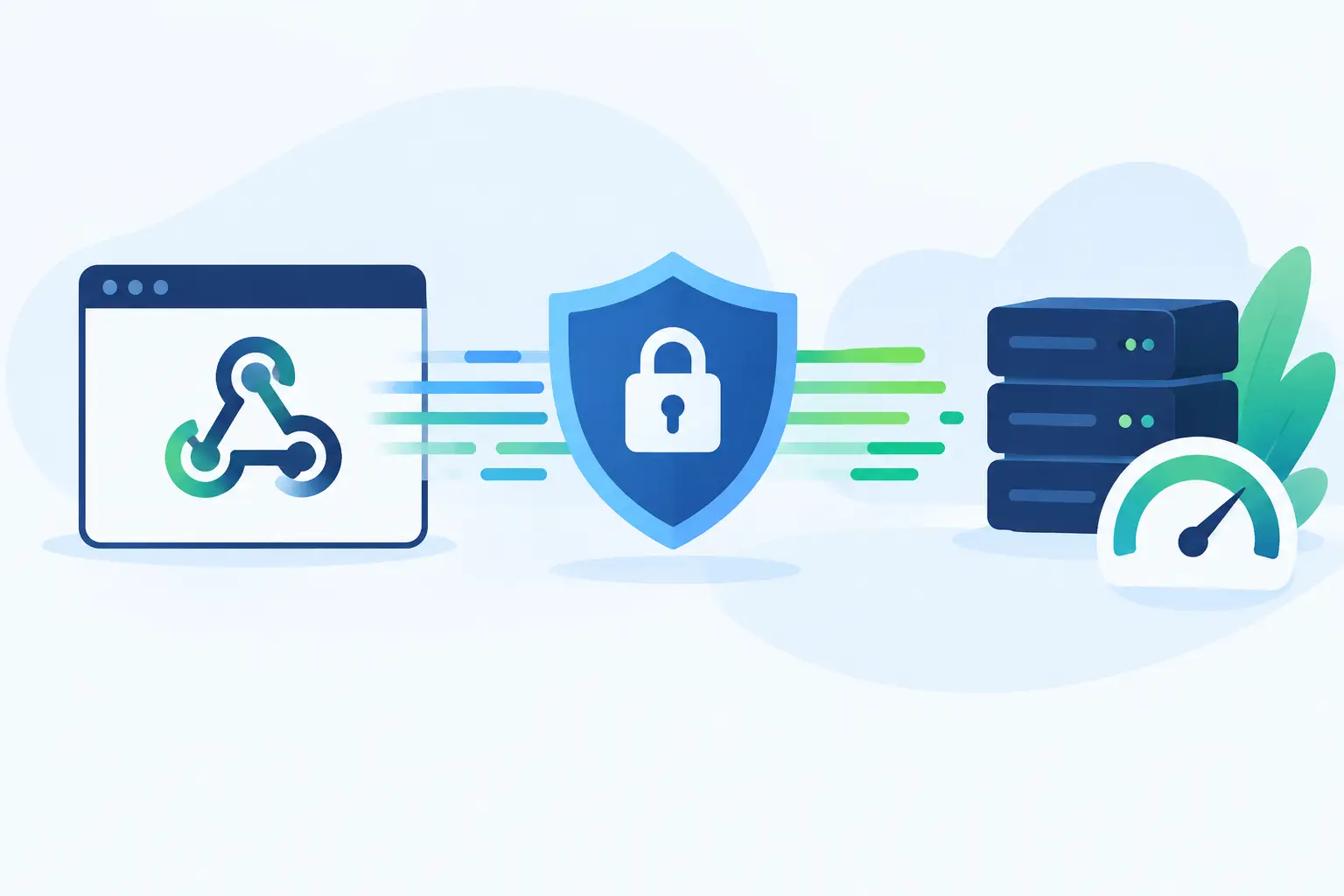
A webhook receiver is an internet-facing API endpoint that often accepts high-value instructions: provision an account, mark an invoice paid, release an order, rotate a credential, or update a deployment. Treating it as a simple callback URL is how teams create an unauthenticated control plane. Knowing how to secure webhook endpoints means proving who sent each request, proving it is fresh and intact, and ensuring valid requests cannot trigger unsafe behavior.
The implementation details vary by provider, but the security model should not. A production webhook endpoint needs layered controls because no single mechanism protects against forged requests, replay attempts, parsing failures, credential exposure, or operational mistakes.
How to Secure Webhook Endpoints at the Trust Boundary
Start by creating a dedicated endpoint for each webhook source or trust domain. Avoid a generic `/webhooks` route that infers the provider from a body field supplied by the requester. Separate routes make signature configuration, authorization policies, logging, rate limits, and incident response more precise.
Require HTTPS for every delivery. TLS protects the webhook payload in transit, but it does not authenticate the sender by itself. A valid certificate only proves that the request reached your domain securely. It does not establish that the caller is your payment processor, source-control provider, or identity platform.
The primary sender-authentication control should be cryptographic signature verification. Most mature webhook providers sign the raw request body with an HMAC secret, asymmetric key, or signed JWT. Your receiver must validate that signature before it parses, transforms, or acts on the payload.
The word raw matters. Providers usually sign the exact bytes sent over the wire. If middleware parses JSON and then serializes it again before verification, whitespace, field order, escaping, and character encoding can change. The signature check will fail, or worse, teams may disable verification to restore functionality. Preserve the unmodified request body, verify it, then parse it.
Use a constant-time comparison function when comparing HMAC values. Ordinary string equality can expose small timing differences that are theoretically useful to an attacker attempting to guess a signature. The practical risk depends on the environment, but constant-time comparison is inexpensive and should be the default.
Webhook signing secrets belong in a secrets manager, not source code, CI variables with broad access, ticket comments, or chat messages. Restrict access by service identity and environment. Production and staging must have separate signing secrets. If a provider supports multiple active secrets during rotation, configure your verifier to accept the current and previous secret for a short, documented overlap period.
Asymmetric signatures can reduce shared-secret exposure because the receiver stores a public key rather than a signing key. That is useful when supported, but key retrieval introduces its own concerns. Cache keys safely, validate key identifiers, enforce issuer expectations, and have a defined response when the provider rotates keys or its key endpoint is unavailable.
Stop Replay Attacks and Duplicate Processing
A valid signed request can still be malicious if it is replayed. An attacker who captures a legitimate delivery may resend it to repeat a state-changing operation. Providers also retry webhook deliveries during network errors, timeouts, and non-2xx responses. Your design has to distinguish a legitimate retry from an unacceptable replay.
First, validate the provider timestamp included in the signed data. Reject requests outside a narrow acceptance window, commonly five minutes. Select the window based on clock reliability and expected delivery delays. A very short window can reject valid events during provider incidents; a large window gives captured requests more time to be reused. Synchronize server clocks with a reliable time source before enforcing this control.
Second, make processing idempotent. Store the provider event ID or delivery ID in durable storage with a uniqueness constraint. If the same event arrives again, return a successful response without executing the underlying operation twice. Do not rely on an in-memory cache for this requirement. It disappears during restarts and does not coordinate across multiple instances.
Idempotency should be enforced at the business-operation level as well. A unique event record protects against duplicate deliveries, but downstream workers, queues, and database retries can still repeat actions. For example, a billing event should be tied to an immutable provider transaction ID, while provisioning should be tied to an operation record that can only transition once.
Validate Payloads Without Trusting Them
Signature verification establishes origin and integrity. It does not make the payload safe for your application. A trusted provider can send malformed data because of integration mistakes, version changes, or unexpected event types. Your endpoint should use strict schema validation before handing data to business logic.
Validate the HTTP method, content type, body size, required fields, data types, enumerated event names, and nested object constraints. Reject unknown event types unless there is a deliberate compatibility reason to retain them. Permissive parsers are convenient, but they allow unreviewed provider changes to reach sensitive workflows.
Set a small body-size limit appropriate to the provider’s documented payloads. This reduces exposure to memory pressure and oversized-body attacks. Disable XML parsing unless a provider explicitly requires it. If XML is necessary, disable external entity resolution and entity expansion. Avoid unsafe object deserialization in every format, including language-native binary serializers.
Never use webhook fields directly as file paths, shell arguments, SQL fragments, URLs for server-side requests, or authorization decisions. A signed payload may contain user-controlled values that originated in an external system. Apply normal input handling: parameterized queries, allowlists, output encoding, and authorization checks against your own system of record.
One common failure is treating a `user_id`, email address, or organization identifier in the webhook as final proof of access. Use the event to locate a local record, then verify that the requested state change is permitted under your application rules. External event authenticity is not a replacement for internal authorization.
Limit Exposure Beyond the Signature
Network controls provide useful defense in depth. If a provider publishes stable source IP ranges, allowlist them at the edge. Keep the list automated and monitored because providers can change ranges. Do not make IP allowlisting your only control: cloud egress ranges shift, proxies complicate source identification, and IP addresses do not cryptographically identify a specific sender.
Mutual TLS is stronger when both parties support it and the integration justifies the operational overhead. It can be appropriate for high-value business-to-business integrations, private connectivity, or regulated environments. For broad third-party SaaS integrations, signed payloads plus TLS are usually more practical.
Apply rate limits and concurrency limits per route. The goal is not only to block abuse but also to preserve capacity for signature verification, database writes, and downstream processing. Place a web application firewall or API gateway in front of public endpoints where it can enforce TLS, request-size limits, basic protocol rules, and DDoS protections without altering the raw body needed for signature verification.
Be deliberate about error responses. Return a generic 401 or 403 for failed authentication, a 400 for structurally invalid requests, and a 2xx response only after the request has been accepted for reliable processing. Do not return signature details, expected headers, stack traces, or secret-related information. Those details belong in protected internal logs.
Separate Receipt From Processing
Webhook providers expect a fast response, often within a few seconds. Calling several internal APIs, generating reports, or performing slow database migrations inside the request path creates timeout-driven retries and duplicate work.
A safer pattern is to verify the signature, validate the minimum required schema, create an idempotency record, and place the event onto a durable queue. Return success only when the event is durably accepted. A worker can then perform the expensive business operation with its own retry policy, permissions, and observability.
This separation has trade-offs. Queues add operational complexity and create eventual consistency. For low-risk events with simple processing, synchronous handling may be acceptable. For payments, identity changes, infrastructure actions, credential rotation, and customer-data updates, asynchronous processing is usually the safer architecture.
Workers should receive only the fields they need. Avoid forwarding an entire unfiltered webhook payload through logs, queues, analytics systems, and error trackers. Redact secrets, authorization headers, tokens, passwords, and personally identifiable information before telemetry is emitted. This is also where disciplined secret collection matters: signing secrets and integration credentials should be distributed through controlled channels, not copied into ad hoc messages or documentation.
Make Failures Detectable and Recoverable
Log security-relevant metadata for every delivery: provider name, event ID, timestamp, signature-verification result, schema result, deduplication outcome, response status, and processing result. Do not log full payloads by default. If payload retention is needed for debugging or audit, encrypt it, restrict access, define a retention period, and document why it exists.
Monitor for signature failures, timestamp rejections, unusual event-type spikes, repeated duplicate IDs, queue backlog, and rising provider retries. A sudden increase in invalid signatures can indicate an integration regression, an unannounced provider change, or active probing. Alert thresholds should account for normal retry behavior so the team is not trained to ignore noise.
Test the receiver with forged signatures, expired timestamps, duplicated event IDs, malformed JSON, oversized bodies, missing headers, unsupported event types, and valid events delivered out of order. Include key rotation and provider retry behavior in integration tests. Security controls that exist only in a runbook are not controls.
The endpoint is secure when a forged request is rejected, a captured request expires, a duplicate request is harmless, and a valid request can be processed reliably without exposing its contents. Build for those conditions before the webhook becomes the quiet path into a critical system.