
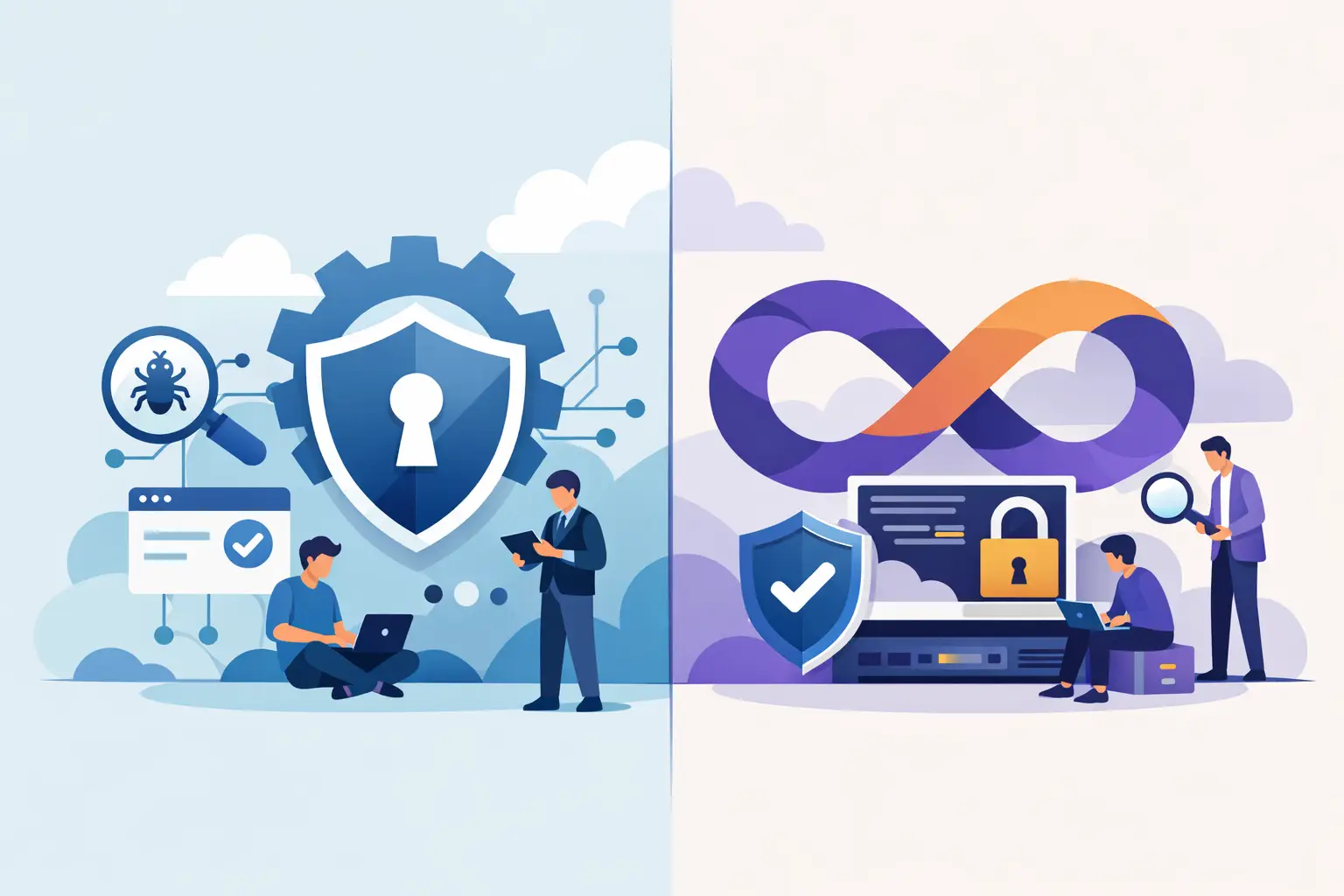
A production credential exposed in a CI log is not primarily a tooling failure. It is an ownership failure. The distinction between DevSecOps vs DevOps security becomes clear at this point: one describes security as an operating model across delivery, while the other often describes the controls used to protect the delivery platform itself.
For SaaS teams moving quickly, the terms are easy to blur. Both involve pipelines, cloud permissions, code scanning, infrastructure as code, and incident response. But treating them as interchangeable creates gaps. A team can secure its Git provider, CI runners, and artifact registry while still shipping an authorization flaw, exposing customer data through an API, or deploying infrastructure with unsafe defaults.
DevSecOps vs DevOps Security: The Core Difference
DevSecOps is a way of building and operating software in which security responsibilities, evidence, and controls are integrated throughout the software delivery lifecycle. Engineering, platform, and security teams share responsibility for reducing risk before code reaches production and for responding when controls fail.
DevOps security, by contrast, usually refers to securing the DevOps environment: source control, build systems, deployment pipelines, container registries, cloud identities, runners, plugins, and operational access. It is a critical discipline, but it is narrower. Its primary question is: can an attacker compromise the systems that build and deploy our software?
DevSecOps asks a broader question: are we systematically producing, deploying, and operating software that resists realistic threats?
The difference matters because modern software supply chains have two attack surfaces. The first is the application and infrastructure delivered to customers. The second is the delivery system that produces it. DevOps security focuses heavily on the second. DevSecOps addresses both, while also establishing how teams make security decisions under delivery pressure.
What DevOps Security Protects
A mature DevOps security program protects the path from a developer workstation to production. That includes strong authentication for source control, least-privilege access to CI/CD systems, isolated build runners, protected branches, signed artifacts, dependency provenance, and carefully scoped deployment credentials.
It also includes administrative controls that are often neglected until an incident occurs. Who can modify a pipeline? Who can add a third-party CI action? Which service accounts can deploy to production? Can a compromised developer token retrieve secrets from build logs or vault integrations? These are high-value questions because pipeline compromise gives an attacker leverage over every environment downstream.
For example, a team may use workload identity to eliminate long-lived cloud keys from CI, lock production deployments behind protected environments, and restrict artifact publication to approved workflows. That is strong DevOps security. It reduces the chance that an attacker can alter a release or move laterally from a build system into cloud infrastructure.
But none of those controls determine whether the released API properly enforces tenant boundaries. They do not tell you whether a new file-upload feature permits malicious content, or whether a Terraform module exposes a database to the public internet. Those problems require a DevSecOps practice.
What DevSecOps Adds
DevSecOps puts security activities into the engineering workflow at the points where design and implementation decisions are made. It does not mean adding every scanner available to a pull request. It means selecting controls that match the system’s threat model and making their output actionable for the people who own the code.
At design time, this can include lightweight threat modeling for new trust boundaries, payment flows, privileged actions, or external integrations. During implementation, it may include secure coding standards, code review expectations, dependency review, secret detection, and targeted static analysis. During deployment and operation, it expands to infrastructure policy checks, runtime visibility, vulnerability prioritization, and incident learning.
The operating principle is not “security reviews every change.” That model becomes a queue, then a bypass. The principle is that teams should have fast, reliable mechanisms for detecting the security issues most likely to matter in their product, with escalation for changes that genuinely need specialist review.
This is why DevSecOps is organizational as much as technical. A scanner can identify an unsafe deserialization pattern. It cannot decide whether the finding is exploitable in a multi-tenant architecture, who should remediate it, or whether the release must stop. Clear ownership can.
Security Ownership Is the Real Separator
The most visible contrast in DevSecOps vs DevOps security is where accountability sits.
In a DevOps security model, a platform or security team may own the guardrails around CI/CD and cloud administration. Product engineering consumes those services. This is appropriate when the platform team has deep expertise in identity, build isolation, network architecture, and operational controls.
In DevSecOps, product teams retain meaningful ownership for the security properties of the services they build. Security specialists define standards, provide tooling, investigate complex risk, and establish assurance. They are not expected to personally approve every configuration file or remediate every vulnerable dependency.
That division should be explicit. Platform teams typically own pipeline hardening, identity patterns, base images, centralized logging, and paved deployment paths. Product teams own application authorization, data handling, input validation, dependency hygiene, and service-specific threat decisions. Security teams own policy, risk frameworks, testing strategy, adversarial expertise, and exceptions. There will be overlap, especially in smaller companies, but ambiguity should not be the default.
Automation Helps Only When It Produces Decisions
Automation is central to both disciplines, yet it is commonly misapplied. Teams add software composition analysis, static analysis, secret scanning, container scanning, and infrastructure checks, then discover that developers receive hundreds of low-context findings. Alert volume rises while risk reduction stalls.
A useful control must have a defined action. If a secret scanner detects a credential, the organization needs a response path: revoke or rotate it, identify where it was used, remove it from history when appropriate, and prevent recurrence. If infrastructure policy blocks a public storage bucket, developers need a documented compliant alternative. If a dependency has a critical vulnerability, the team needs exploitability context and an agreed remediation window.
This is also where false confidence becomes dangerous. A clean scan does not prove an application is secure. Automated controls are strongest when they enforce deterministic requirements, such as prohibiting public ingress, requiring encryption, blocking committed secrets, or preventing unsigned production artifacts. They are weaker at understanding business logic, authorization intent, and complex abuse cases.
Secrets Are a Shared Failure Domain
Secrets illustrate why separating the two concepts too sharply can be harmful. DevOps security must prevent secrets from leaking through CI variables, build logs, configuration stores, and deployment identities. DevSecOps must also prevent application teams from embedding secrets in code, sharing credentials through chat, or building workflows that normalize uncontrolled access.
The receiving path matters as much as storage. When a client, contractor, or partner needs to submit a password, API key, or certificate, email and chat create copies that are difficult to inventory and nearly impossible to govern well. A controlled collection workflow reduces this exposure before the secret enters a vault or deployment system.
Securitae supports that boundary with account-free Secure Links for collecting sensitive credentials, encrypted handling, and synchronization to approved destinations. For teams building secure delivery practices, this is not a substitute for identity design or vault policy. It is a practical control for one of the most routine ways secrets escape formal systems.
Choosing the Right Starting Point
A company does not need a fully mature DevSecOps program before it secures its pipelines. If production deployments rely on shared administrator accounts, unmanaged CI tokens, public runners, or mutable artifacts, fix those conditions first. A compromised delivery system can invalidate many other controls.
Conversely, a well-defended pipeline is not a reason to postpone application security. If the product processes regulated data, exposes public APIs, supports multi-tenancy, or enables privileged financial or administrative actions, threat modeling and application-focused testing should start early. The cost of retrofitting authorization boundaries or data isolation is usually far higher than the cost of building them deliberately.
A pragmatic sequence is to establish a trustworthy delivery foundation, then embed a small number of high-signal product controls into normal engineering work. Measure whether findings are remediated, whether exceptions are documented, and whether recurring classes of defects decline. Compliance evidence may follow from this work, but it should not be the only reason it exists.
The best security program is not the one with the most gates. It is the one that makes unsafe paths difficult, secure paths practical, and ownership clear before the next release turns a minor shortcut into a production incident.