
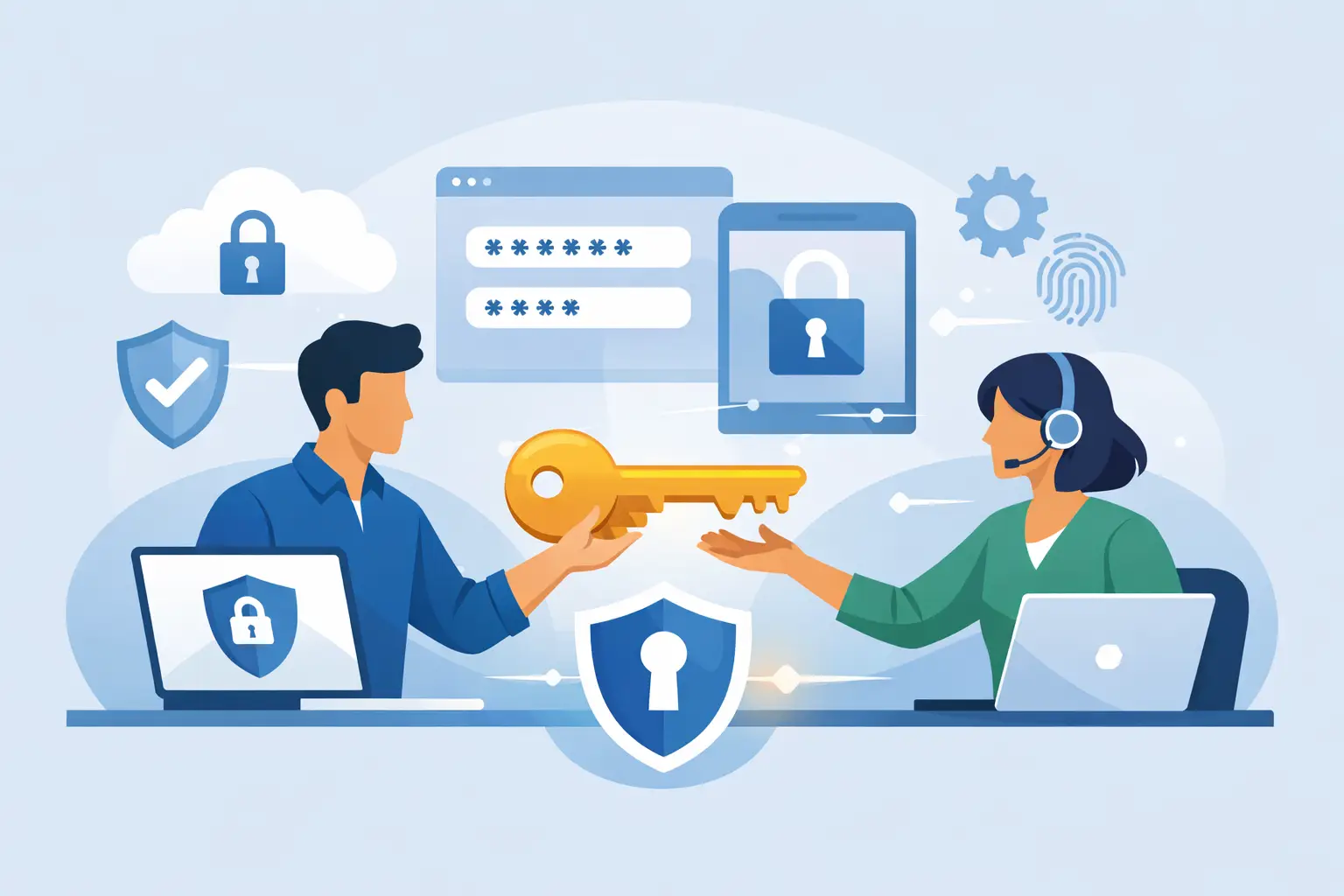
A password handoff is often treated as a small operational task: a contractor needs production access, a customer needs to provide an API key, or an incident responder needs a credential immediately. That assumption creates risk. Password handoff best practices turn a casual exchange into a controlled security process with defined recipients, limited exposure, and evidence that the secret was handled correctly.
For technology teams, the issue is broader than passwords. The same workflow applies to API tokens, private keys, recovery codes, database credentials, cloud access keys, and configuration values. Any secret that moves outside its system of record can become an unmanaged copy. That is where security debt starts.
Treat every handoff as a temporary exception
A secret should not be shared merely because someone asks for it. Start by deciding whether the recipient actually needs the credential itself or only needs access to the system behind it. The preferred answer is usually access through an identity provider, a role-based permission assignment, a delegated integration, or a just-in-time access workflow.
If direct secret transfer is unavoidable, treat it as a temporary exception. Define the business purpose, the intended recipient, the expiration point, and the owner responsible for revocation. This discipline prevents a short-lived support request from becoming a permanent, undocumented access path.
The trade-off is speed. In an outage, a formal approval chain can slow restoration work. That does not justify sending a production password through chat. It means the incident process should include a preapproved emergency handoff path with strict logging, narrow access, and mandatory rotation once the event is over.
Use a purpose-built secret-sharing channel
Email, chat, ticketing platforms, and shared documents are poor channels for password transfer. They create durable copies, expose secrets to mailbox searches and message retention policies, and often make it difficult to determine who accessed the information. Deleting the original message rarely removes backups, archives, notifications, or copied content.
A password manager with controlled sharing is a strong choice when both parties are known members of the organization and can authenticate to the same environment. For external clients, vendors, and customers, that requirement often introduces friction. Asking a client to create an account, join a vault, and learn a new tool can lead them back to email.
Use a secure collection or sharing mechanism that lets recipients submit or retrieve a secret without exposing it in transit through a general collaboration system. The channel should encrypt data, bind access to a specific link or authenticated identity, and provide controls for expiration and revocation. For high-risk exchanges, burn-on-view behavior can reduce the number of times a secret is available for retrieval.
Securitae is designed for this practical gap: a Secure Link can collect credentials from a third party without requiring that person to create an account, while keeping the resulting secret out of email and chat workflows.
Verify the recipient outside the handoff channel
Secure delivery does not solve misdelivery. A correctly encrypted secret sent to the wrong person is still a security incident.
Before sending or requesting a credential, verify the recipient through an independent channel. For an established vendor, this may mean confirming a known contact through a documented phone number or an existing ticketing relationship. For a customer, it may mean validating the request against an authorized administrator list. Never rely solely on a reply-to address, a chat display name, or an urgent request that appears to come from an executive.
This matters most when credentials relate to cloud administration, source control, production databases, or financial systems. Business email compromise attacks frequently succeed because teams accept a plausible request and treat the handoff itself as proof of legitimacy.
For sensitive transfers, use a two-part verification model. Send the secure link through one channel and provide the access code, recipient confirmation, or retrieval instruction through another. This adds a small amount of friction, but it meaningfully reduces the impact of a compromised inbox or hijacked chat account.
Limit the secret’s useful life
A handoff should have an end date. Set a short expiration for the transfer link, especially for one-time customer onboarding, incident response, or vendor troubleshooting. Once a recipient has retrieved the secret, remove the sharing path where possible.
Then ask a second question: how long should the credential itself remain valid? If a password was provided to a contractor for a specific task, rotate it after completion. If an API key was supplied by a customer, move it into the appropriate vault or encrypted configuration store, then avoid reusing it across environments. If a recovery code was disclosed, generate a new one immediately after use.
Rotation is not always cost-free. Rotating a legacy service credential can break integrations that were never properly inventoried. That is not a reason to skip rotation. It is evidence that the service needs ownership, dependency mapping, and a migration plan toward scoped, nonhuman identities.
Keep secrets out of operational exhaust
Secret exposure frequently happens after the handoff, not during it. An engineer pastes a credential into a troubleshooting ticket, a support agent copies it into CRM notes, or an automation script prints it to build logs. Each action creates another location that must be secured, retained appropriately, and eventually removed.
Build handling rules around the destination. Production secrets belong in an approved vault, an encrypted secret manager, or a controlled password manager item. They do not belong in issue trackers, local text files, browser notes, screenshots, or unencrypted spreadsheets.
Engineering leaders should also verify that CI/CD systems redact known secret patterns and prevent credentials from being written to logs. Repository scanning is necessary, but it is a recovery control. The stronger control is ensuring that teams never need to paste secrets into source code, deployment variables, or pull request comments in the first place.
Create accountability without overcomplicating the workflow
A usable handoff process needs an audit trail, but not every transfer needs a lengthy form. Capture the minimum information that supports investigation and governance: who requested the handoff, who approved it when approval was required, what system the secret related to, who received it, and when the access path expired or the credential was rotated.
Separate the audit record from the secret value. A ticket can state that a production database credential was securely shared with an on-call engineer under an incident reference. It should not contain the credential itself. This distinction lets security and compliance teams review activity without broadening access to sensitive material.
For regulated environments, define retention rules for the audit metadata and validate that the chosen platform can support your evidence requirements. The right level of logging depends on the data classification, the system’s criticality, and contractual obligations. A low-risk sandbox integration does not require the same controls as privileged production access.
Design for external parties and offboarding
External handoffs deserve special attention because the receiving party is outside your identity boundary. Do not assume that a vendor’s internal security controls match yours. Scope the shared credential to the precise integration, set an expiration, and avoid granting broad administrator rights for convenience.
When an engagement ends, remove access systematically. Review shared vault items, active secure links, API keys, SSH keys, service accounts, and emergency credentials created during the relationship. Offboarding should also include the less obvious handoffs: credentials sent during implementation, temporary support access, and recovery information provided during an incident.
A periodic review helps uncover handoffs that became invisible. If no individual or team can explain why a credential exists, who uses it, and how it is rotated, that credential should be treated as a risk until proven otherwise.
Make the secure path the easiest path
Policy alone will not stop people from sending passwords through chat when they are under pressure. The secure workflow must be faster than the unsafe workaround. Give teams a standard request path, clear guidance for internal and external recipients, and approved tools that do not force unnecessary account creation or complex setup.
The best password handoff process is rarely the one with the most controls. It is the one engineers, support teams, and customers can follow correctly when the request is urgent. Build that path before the next credential needs to move, then make rotation and cleanup part of the same operating habit.